Select a site alphabetically from the choices shown in the box below. Alternatively, browse sculptural examples using the Forward/Back buttons.
Chapters for this volume, along with copies of original in-text images, are available here.


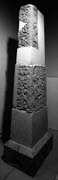
Object type: Cross-shaft reconstructed from three fragments [1]
Measurements:
Dimensions as presently reconstructed:
H. 147 cm (58 in); W. 48.5 > 43.5 cm (19.5 > 17 in); D. 36 > 23 cm (14 > 9 in)
Upper fragments:
H. 58.5 cm (23 in); W. 19 cm (7.5 in); D. 23 > 21.5 cm (9 > 8.5 in)
Lower fragment:
H. 58.5 cm (23 in); W. 48 > 44 cm (19 > 17.25 in); D. max. 32 > 28.5 cm (12.25 > 11.25 in)
Stone type: The lowest block is a coarse, shelly, poorly sorted oolite with the bedding planes vertical. Shell fragments are up to 8mm long and 2mm thick. Some ooliths have weathered out to give an 'aero-chocolate' texture. There are three 'watermarks' on the back of the stone, which is a bedding surface covered in bivalve fragments. Bath stone, Chalfield Oolite Formation, Great Oolite Group, Middle Jurassic
Plate numbers in printed volume: Pls. 104-13; Fig. 22j–l
Corpus volume reference: Vol 7 p. 114-6
(There may be more views or larger images available for this item. Click on the thumbnail image to view.)
Three joining stones now reconstructed into a single cross, in a different formation from the reconstruction which stood in the churchyard (see R.C.H.M.(E.) 1972, pl. 2).
Upper shaft, 1a–b.
A (broad): Only part of this face survives, the rest having been made up with a new block in the reconstruction. The carved portion consists of two joining stones, edged with a flat-band moulding and carved in deep relief. At the top, a grape bunch on a curving stem which emerges from behind three stiff acanthus leaves. Below, curling fronds filling the space around a circle of radial stiff leaves enclosing a feature which is impossible to decipher, possibly a face.
B (narrow): Lost, replaced by modern stone in the reconstruction
C (broad): Partly replaced by a new block: a surviving section had been chiselled back for reuse as a windowhead, the shape of which is now hidden in the reconstruction.
D (narrow): Two joining fragments cut by the formation of the window-head, and edged by a flat-band moulding on the top and sides. The carving is deep and crisp. An acanthus scroll, with deeply incised stems and leaves, terminates at the top with a single berry bunch. Each volute is filled with three curling leaves bound into the stems or sides of the frame with double U-shaped clips. Within the spandrels of the volutes are tiny rosette flowers.
Lower shaft, 1c.
All faces are enclosed in flat-band mouldings.
A (broad): This face is very worn. An acanthus tree-scroll with a straight central stem springs from a rounded threeelement root. At the base is a pair of large curling fronds; their leaves are veined and terminate in heavy rounded tips. They are crossed by incised strands which spring from the root and the space between them is filled with two small tendrils. Touching the top of the leaves is another pair of tendrils, and filling the space above them is a pair of small rosettes. Two affronted quadrupeds fill the upper space, their legs straddling the rosettes, and heads bent back to grip a plant tendril in their jaws. The one on the left is the most visible, it has a small pricked ear, rounded head with long jaws, and a round eye.
B (narrow): Very eroded single tree-scroll. The straight median-incised stem springs from a triangular root. Two large curling acanthus leaves with their lobed tips turning inwards are linked by a ring to the central stem. Above are two tiny outcurving shoots, and then a pair of curling leaves, smaller and more irregular than those below and linked by a similar ring. The top of the plant branches into two leaf-flowers in which the central pointed 'buds' are deeply cut.
C (broad): The acanthus scroll is similar to face A: the central stem springs from a stepped root composed of three elements which are the same form as the clips. From these sprout a pair of large curling acanthus leaves with heavily lobed tips, linked by an incised strand. Above are two space-filling pellets, and touching these a pair of single inturned leaves clipped to the edge of the frame. The plant terminates in a pair of inward curling leaves which are also clipped, and flanked by long incised buds.
D (narrow): Although one edge of this face is missing, the details of the single tree-scroll are much clearer than on face B. The formula is however the same: a straight central stem springs from a triple domed base, and linked to it by rings are two pairs of heavily veined leaves, with inward curling tips terminating in heavy lobes. The space between the pairs of leaves is filled with two pellets or buds. At the top of the plant a single pair of outurned leaves are separated by three buds.
As noted in the introduction (p. 51) the more varied plant-scrolls — often with leaf-flowers and grape bunches — give way under the influence of the 'Winchester style' manuscripts to plants which are more acanthus-like. In the more intractable medium of stone, however, the luxurious exuberance of the leaves is simplified and elements are emphasised. Here the bold pairs of curling veined leaves, and the binding rings, are reminiscent of the more static manuscript examples such as the frame in the Kederminster Gospels, fol. 84 (Backhouse et al. 1984, 69–70, pl. 51), which is dated to the early eleventh century. Similar compositions in sculpture are to be found on two sides of the Littleton Drew shaft (Ills. 455, 457) and also in the base panel at Colyton, Devon (Ill. 3). Distinctive of these scrolls is the triple domed root and the domed / U-shaped clips which attach the leaf scrolls to the frames. These clips are found on both the upper and lower stones here, and similar clips are also found at Littleton Drew and Colyton.
Although the plant forms of Todber are reminiscent of later manuscripts, there are some elements which are shared with the other crosses which seem to be earlier, namely the combination of grape-bunches with acanthus on the upper shaft and the paired animals on the lower shaft. Plunkett (1984, 202–11) discusses this piece in relation to his 'Colyton School', which includes also Nunney, Somerset (Ills. 316–19; see introduction p. 51), and would see all the productions as a reflection of monastic patronage in the tenth century. Unlike Colyton, however, the leaf forms are quite consistent and do not include the ivy leaves or leaf-flowers with curling stamens which can be found in tenth-century manuscripts (see introduction p. 54). I have therefore placed this piece later in the scroll series.
[1] The base fragment is designed as a complete panel and some commentators have considered that there were two crosses here (Plunkett 1984), but there is no discernable difference in the cutting, and the present reconstruction has been accepted although the surviving fragments are illustrated separately.
[2] I am grateful to Hugh Harrison for his slides showing the individual pieces in the process of conservation
