Select a site alphabetically from the choices shown in the box below. Alternatively, browse sculptural examples using the Forward/Back buttons.
Chapters for this volume, along with copies of original in-text images, are available here.


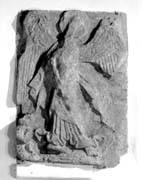
Object type: Figure panel
Measurements: H. 84 < 89 cm (33 < 35 in); W. 61 cm (24 in); D. max. 12.5 cm (5 in)
Stone type: Greyish orange (10YR 7/4), coarsely shelly, matrix-supported limestone. A few scattered quartz grains and ooliths (or very well-rounded shell fragments). A few small, scattered, dark (?siderite) grains together with some larger (up to 3 mm) pieces. Some of the wellrounded clasts and larger patches are limonitised. Shell fragments (thin bivalves), up to 10 mm across, not aligned and generally pale grey in contrast to matrix. Ham Hill Stone Member, Bridport Sand Formation, Lias Group, Lower Jurassic
Plate numbers in printed volume: Pl. 100
Corpus volume reference: Vol 7 p. 113-4
(There may be more views or larger images available for this item. Click on the thumbnail image to view.)
A (broad): Figure of an angel, with a creature below. The figure is now headless but the line of the neck and the circular dished halo survive. The figure's wings are displayed, with the right wing partly obscured by drapery, with V-shaped incisions for the upper wings and long pinions; the other wing is detailed with three rows of upper feathers. The figure is walking to the spectator's right, his left foot fully turned and right foot half forward, and both firmly placed on the scaly body of a creature whose tail is coiled behind the figure; but its head, which would have been in the bottom right hand corner, is lost. The angel's head seems to have been inclined forward and his left arm crosses his body diagonally. His right arm, covered by the flying fold of drapery which is nearly obliterated, may have been extended and holding a shield. The drapery at the hem line falls in scalloped folds with flares at front and back, and is finely detailed.
In its original state the figure must have been in high relief, with lesser relief for the delicately detailed wings and drapery folds. It is not clear what this piece might have been part of, but possibly a frieze. Although in the past I have interpreted this as part of an Annunciation scene and therefore an image of St Gabriel, now that it has been cleaned it is without doubt St Michael in the act of spearing a dragon, a scene which, despite the importance of that archangel as the enemy of the dragon — Satan — from the earliest Christian period, is not widely current in western art until comparatively late (see introduction p. 61 on angels). As the millennium approached there was an increased interest in the Apocalypse and the Last Judgement, and the role of Michael the vanquisher of the dragon in Revelation 12.7–9 became more prominent in popular piety. The cult of Michael was indeed strongest from AD 950–1050 (Keck 1998, 45) as is evidenced from manuscripts. St Michael is shown in the act of killing the dragon in, for example, BL MS Cotton Tiberius C. vi, fol. 16 which is dated by Wormald about 1050 (Wormald 1952, 50 and pl. 32). Talbot Rice specifically linked Stinsford with the manuscripts of the Winchester School, placing it shortly after rather than before AD 1000 (Rice 1952, 94), and indeed the delicate treatment of the wings and the drapery folds as well as the kicked-out hem line is well paralleled in manuscripts of the late tenth and early eleventh centuries. It has most in common with the scene on a stone from Ipswich (Okasha 1971, 82–3, pl. 58) which has an explanatory inscription in Old English and St Michael with sword and shield fighting a very dominant dragon. This has been dated to the eleventh century. Although the scene is also found on tympana of the late eleventh and twelfth centuries such as Hallaton, Leicestershire (Pevsner 1960, 117) or Moreton Valence, Gloucestershire (Zarnecki 1951, pl. 31), the drapery style seems to place Stinsford clearly in a pre-Conquest context. It is of interest that the church still bears the dedication to St Michael and it is possible that this panel survived in the church throughout the Middle Ages.
