Select a site alphabetically from the choices shown in the box below. Alternatively, browse sculptural examples using the Forward/Back buttons.
Chapters for this volume, along with copies of original in-text images, are available here.


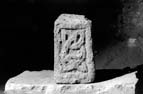
Object type: Fragment
Measurements: H. 21.5 cm (8.5 in); W. 16 cm (6.25 in); D. 12.5 cm (4.75 in)
Stone type: Yellowish grey (5Y 7/2), medium-grained, matrix-supported, very shelly oolite. Elongate shells up to 4 mm form up to about 10% of the rock. The ooliths, which vary in size from 0.4 to 0.6 mm, weather out to give an 'aero-chocolate' texture. Bath stone, Chalfield Oolite Formation, Great Oolite Group, Middle Jurassic
Plate numbers in printed volume: Pls. 16-19
Corpus volume reference: Vol 7 p. 89
(There may be more views or larger images available for this item. Click on the thumbnail image to view.)
It is uncertain which way up this piece should be viewed. It is surrounded by broad flat-band edge mouldings on the complete faces.
A (broad): Part of the moulding survives on three sides. The ornament is partly obliterated by mortar but seems to be a pattern E knot conjoined to a more intricate but indecipherable knot below.
B (narrow): Broad flat-band mouldings enclose two linked pattern E knots with median-incised strands.
C (broad): Broken at an angle, but part of the moulding survives enclosing traces of interlace.
D (narrow): Broken, but part of a dowel hole, which has been cut through at an angle, survives.
E (top but originally probably the base): Uneven, but some dressed surface survives.
F (base but originally probably the top): Flat and smoothly dressed.
It is difficult to know whether this is part of a panel at the top of a cross-shaft or part of the lower arm of the head, in which case this could have been dowelled into the shaft. It was once quite a handsome free-armed cross-head, with well cut median-incised interlace.
