Select a site alphabetically from the choices shown in the box below. Alternatively, browse sculptural examples using the Forward/Back buttons.
Chapters for this volume, along with copies of original in-text images, are available here.


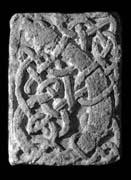
Object type: Block
Measurements: H. 41.5 cm (16 in); W. 31 cm (12 in); D. 18.5 cm (7.25 in)
Stone type: Poorly sorted, matrix-supported, shelly oolite. About equal proportions of ooliths weather out ('aerochocolate' texture) or stand proud. Ooliths are mainly in the range 0.3 to 0.5 mm diameter, but some are up to 0.9 mm diameter. Shell fragments up to 4 mm across (the larger ones obviously bivalves); all are abraded, with the smaller ones fairly well rounded. Bath stone, Chalfield Oolite Formation, Great Oolite Group, Middle Jurassic
Plate numbers in printed volume: Pls. 322-3
Corpus volume reference: Vol 7 p. 175
(There may be more views or larger images available for this item. Click on the thumbnail image to view.)
There are remains of carving on two sides, but the smooth top with the dowel hole appears to be a finished face. Reverse and base impossible to examine.
A (broad): This face has a flat-band moulding on the top and right-hand side, and contains a ribbon animal with a wide body which tapers into a median-incised strand of interlace to form its tail. The tail loops around the body and fills the space between its head at the top left and the curve of its body. There are faint traces of a midrib and incised herringbone hatching surviving. Its head is seen from above, separated from the body by a collar of beading. It has a squared-off muzzle, with dotted nostrils, backpointed eyes divided by a double V, and prominent rounded ears.
B and C: Cut away
D (narrow): The lower part of the face is cut back and includes a secondary cramp hole. Part of the flat-band moulding survives at the top, and encloses part of a ribbon animal curved in a U-shaped loop. Within the curve of the body are some crossing strands of interlace, one end of which passes under the body and terminates in three claws.
E (top): Plain and dressed, but contains dowel hole in centre, diam. 3 cm > 2.5 cm (1.25 > 1 in), depth 12 cm (4.25 in).
This belongs to the 'ribbon animal' group discussed in the introduction (p. 42), the closest similarity being to Tenbury Wells, Worcestershire (Cottrill 1935, pl. XVI; see Ill. 547), but Plunkett has pointed out that its head in silhouette is exactly like Colerne 1a (Ill. 433), and that the same curve (probably from a template) has been used as at Colerne, thus implying a common origin for these pieces (Plunkett 1984, II, 279, figs. 45 and 46).
