Select a site alphabetically from the choices shown in the box below. Alternatively, browse sculptural examples using the Forward/Back buttons.
Chapters for this volume, along with copies of original in-text images, are available here.


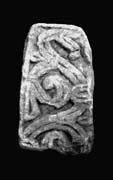
Object type: Part of a cross-shaft
Measurements: H. 35 cm (14 in); W. 20 > 15 cm (7.75 > 5.75 in); D. 16.5 cm (6.5 in)
Stone type: Pale grey (N7), medium-grained, very shelly, very sparsely oolitic, clast-supported limestone. The ooliths are mostly 0.4 mm diameter; some ooliths weather out to give an 'aero-chocolate' texture, others weather proud. Shell fragments (bivalves) range from 0.5 to 2.5 mm across, with some elongate pieces up to 8 mm. Most shell fragments are sub-angular to sub-rounded. Crude bedding is picked out by the elongate shell fragments. Probably Bradford stone, but only sparsely oolitic, Forest Marble Formation, Great Oolite Group, Middle Jurassic
Plate numbers in printed volume: Pls. 316-319
Corpus volume reference: Vol 7 p. 173-4
(There may be more views or larger images available for this item. Click on the thumbnail image to view.)
A: A flat-band moulding survives on three sides, enclosing a plant-scroll with sharply angled tendrils in which the strands are median-incised, one fastened with a domed clip. The leaves in the volutes are long and curling with lobed tips, and deeply incised, as is the bud which separates the upper volutes.
B: Two affronted birds, their heads craning backwards to grasp at their feet.
C: Cut away
D: Part of a plant-scroll with crumpled leaves, buds, and a flat-band moulding on one side to which the scroll is clipped. There is a bird with back-turned head at the upper end.
The foliage type here is a poor relation to Maperton, Colyton and Todber (Ills. 304, 3–4, 106–13), but many of the characteristics survive, such as the long curling leaves with lobed tips, the domed 'clips', and possibly the birds (see introduction p. 51). Plunkett (1984, I, 210) notes that the paired birds with craning necks are'a recognisable C10th form, comparable for instance to those on the Thames censer, that from Canterbury, or on a cruet from London (Wilson 1964, nos. 44, 9, and 147)'. He also notes that the type is long lasting since craning birds are also found on the Fuller brooch (Wilson 1964, no. 153). These however are flatter and more mannered and have probably been influenced by the simpler types of interlaced reptiles so common in Wessex (see introduction p. 42).
