Select a site alphabetically from the choices shown in the box below. Alternatively, browse sculptural examples using the Forward/Back buttons.
Chapters for this volume, along with copies of original in-text images, are available here.


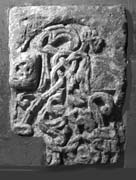
Object type: Slab
Measurements: H. 54.5 cm (21.5 in); W. 40 cm (15.75 in); D. Built in
Stone type: The very heavily patinated stone consists of a greyish yellow (5YR 8/4), poorly sorted, bioclastic and oolitic, matrix-supported, limestone. The clasts are mostly sub-rounded to rounded, with a few sub-angular and also platy. The ooliths are mostly in the range 0.3 to 0.5 mm diameter. The clasts range from 0.4 to 3.0 mm across, but are mostly between 0.5 and 1.0 mm across. There is a mixture of ooliths weathering out to give an 'aero-chocolate' texture and standing proud. One small cleaned-up section towards the outside edge in the middle of the left-hand side showed a medium-grained (0.3 to 0.4 mm diameter), matrix-supported oolite with ooliths weathering out to give 'aero-chocolate' texture. Bath stone, Chalfield Oolite Formation, Great Oolite Group, Middle Jurassic
Plate numbers in printed volume: Pl. 304; Fig.22b
Corpus volume reference: Vol 7 p. 171
(There may be more views or larger images available for this item. Click on the thumbnail image to view.)
The design, which has been cut into a rectangular slab, is outlined by a segmental arch at the top, then narrows between two projections and expands again into what seems to be a rectangle within broad borders. The effect is to give the main field of ornament a cruciform shape with a rounded upper arm and rectangular side arms. The projection on the left, 3 cm deep, is carved with an encircled interlace motif or ring knot; that on the right is in lower relief and is not carved save for two diagonal incised lines. The main field is filled with a tangled plant-scroll with median-incised stems. The arched head contains a large curling leaf with incised triangular centre, and a smaller leaf-flower with scooped heart-shaped leaves or petals and a central bud. Their stalks then cross and sprout heavy tendrils which are clasped by rectangular clips. Looping through their strands are a pair of long half-moon leaves (Cramp 1991, fig. 11) and towards the base are other leaf-flowers with buds, their surfaces very worn.
Most of the elements in this scroll can be paralleled in other Wessex sculptures, notable Chew Stoke 2 (Ill. 202), or Littleton Drew (Ills. 455–8), and I have previously pointed out the scooped or outlined centres of the plant elements as distinctive of the south-west (Cramp 1975, 193). I did previously describe this Maperton piece as a 'cross' (ibid., fig. 19b) which it is certainly not, nor is it, as Dobson suggested (1931, 187), the head of a cross. It has in fact the appearance of a trial slab, attempting all the currently fashionable plant forms; and the two side projections — the one with a single ring knot and the other with simple scratched incisions — further illustrate the experimental nature of the piece. Both of these elements could be later, but on the whole this is a curious piece which might have been intended as a grave-cover or might just have been unfinished.
