Select a site alphabetically from the choices shown in the box below. Alternatively, browse sculptural examples using the Forward/Back buttons.
Chapters for this volume, along with copies of original in-text images, are available here.


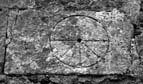
Object type: Sundial
Measurements: Diam. 25.5 cm (10 in)
Stone type: Greyish orange pink (5YR 7/2), very shelly, bioclastic, oolitic limestone. Ooliths occur in patches and form less than 50% of the rock; ooliths, which are mostly 0.3 to 0.5 mm diameter, weather out to give an 'aerochocolate' texture. Abundant shell fragments, mostly as platy laths, vary from 0.3 to 2 mm across. Bradford stone, Forest Marble Formation, Great Oolite Group, Middle Jurassic
Plate numbers in printed volume: Pl. 382
Corpus volume reference: Vol 7 p. 194
(There may be more views or larger images available for this item. Click on the thumbnail image to view.)
The dial is inscribed on a rectangular block of stone in a circle with a prominent gnomon hole in the centre of the horizontal dividing line. The horizontal line is marked with a cross at each end and the lower half contains five crossed lines, leaving broad segments at each side. It is possible that these once contained more lightly inscribed uncrossed lines (see below), but today only the five lines are visible.
Appendix D item (sundials alleged to be of pre-Conquest date).
Horne has identified this as a scratch dial, but one of the features of such dials — that they are not cut into their own plate but directly onto the face of the wall — does not apply to this dial, which is cut into a discrete block. Green saw the five crossed lines marking the middle of the tides and two uncrossed lines marking the beginning as 'distinctly Saxon features, but in other respects the dial more closely resembles a mass-clock than any other dial described in this paper' (Green 1925, 502). He also noted that this was the most westerly dial that he knew (ibid.), and it is true that this is still the case if one excludes more doubtful examples.
Foster, who provides a scaled drawing, notes only five lines and says that the dial 'contains [a] pronounced noon line and each of the quadrants is marked by divisions of an eighth and two sixteenths of a day' (Foster 1987, 76, fig. 15). She concludes that the dial is probably an intermediate type (ibid., 68). The dial does seem to be the octaval type and so could reasonably be placed in the pre-Conquest period, and I am grateful to Dr Frank Evans for his opinion (pers. comm.) that this dial could be considered Anglo-Saxon and of mid eleventh-century date.
