Select a site alphabetically from the choices shown in the box below. Alternatively, browse sculptural examples using the Forward/Back buttons.
Chapters for this volume, along with copies of original in-text images, are available here.


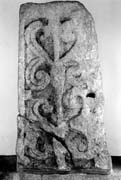
Object type: Fragment of shaft
Measurements: H. c. 79 cm (31 in); W. 45 > 33.5 cm (17.75 > 13.25 in); D. 32 > 29 cm (12.5 > 11.5 in)
Stone type: As Littleton Drew 1a, pale yellowish grey to brownish yellow oolite, with a calcite matrix containing closelyset ooliths mostly of 0.4mm diameter. Thin shell fragments (up to 5mm diameter) are aligned in streaks parallel to the front and back faces of the block (as mounted). Bath stone
Plate numbers in printed volume: Pls. 455-6; 460; Fig. 22n
Corpus volume reference: Vol 7 p. 221-2
(There may be more views or larger images available for this item. Click on the thumbnail image to view.)
A (broad): Abutting the west wall of the porch and covered with cement. However in 1903 when the two fragments were still standing on either side of the path this face was visible, though 'much broken', and the remains of an inscription were described and drawn by Browne (1903, 174–5, fig. 12). [1]
Reported inscription See John Higgitt's discussion below.
B (narrow): Cut back
C (broad): Acanthus tree-scroll with two simple paired sets of leaves, the uppermost sprouting from a cup. One roll moulding survives and a wide band at the top.
D (narrow): Segmented stem, and from each of the four segments tendrils sprout on either side and interlace. This side is less worn than face 1aD at the base.
E (top): Round socket hole, diameter 5 cm (2 in), probably to hold the cross-head. The surface is very smooth with traces of pink plaster.
Reported inscription Browne (1903, 174–5, fig. 12) reported traces of an inscription on what was in his time (and, in its new position, is still) the west side of the west stone (the upper section of the cross-shaft). This face of the stone has been set against the inside of the west wall of the porch and so cannot now be seen. Browne's figure (see Ill. 460) shows four capitals, the first and last of which are incomplete at the top. He disarmingly writes that his figure 'shows quite all that remains of the inscription, perhaps a little more than is really there.' These were large letters, 'much larger than those on the Ruthwell cross', that is to say taller than the tallest of the Ruthwell letters (c. 5.5 cm). He gives the height of one of the letters (A) as 'a little over three inches long' (perhaps about 8 cm). This would seem indeed to have been unusually large lettering for an Anglo-Saxon inscription on stone. The capitals in Browne's figure, if correctly represented, may have read: — LGAN — (or perhaps — LCAN —). The G (or perhaps C) seems to have been a rectangular version of the letter (cf. Okasha 1964–8, table 1 a). The A is shown with a horizontal head-bar and a broken cross-bar. Given Browne's words of caution about his figure, all that can be said about the lettering is that it seems to have consisted of capitals, some of which were variants of their 'Roman' forms. The west face was one of the two broad faces of the cross, but Browne did not make clear where on the west face of the stone these letters could be seen. If Browne was right in seeing an inscription on this stone, the cross would have been comparable with some twenty other Anglo-Saxon crosses in displaying an inscription on the shaft of the cross. As the stone on which he claimed to have seen the lettering was the upper section of the shaft, the inscription may have resembled the six or so of these crosses on which the inscription was set in a panel at the top of one of the broad faces (Higgitt 1986b, 129–30).
There is no doubt that these two fragments formed part of the same shaft, and the pattern on face D of this piece is identical with face D on the lower shaft, Littleton Drew 1a (Ills. 456, 458). If one accepts that these two faces join, then the two surviving broad faces must have been opposed (Plunkett 1984, II, pl. 84). It therefore seems probable that the 'much broken' upper fragment of face 1bA with the inscription would have completed the tree-scroll visible on 1aA below (see Ills. 460–1).
In their original condition the acanthus plant-scrolls which ornament the surviving sides must have been very striking. They are on a larger scale than any other in Wessex, although the Todber scrolls are similarly bold (Ills. 104–13). The differences in media and scale make comparisons between sculptures such as these and acanthus ornament in manuscripts particularly difficult, especially since the details of the carvings are so worn. The organisation of the scrolls with leaves sprouting from straight segmented stems is part of a tradition which may find its earliest extant expression at East Stour (Ills. 57–64) and is closely similar to the plant on the back of the Alfred Jewel (Backhouse et al. 1984, ill. 13), but the leaf types on the broad faces are different from both of these and are fully acanthus-like. As such they may be compared with Cambridge, Corpus Christi College MS 183, fol. 1v (Ill. 530; Temple 1976, no. 6, ill. 29) or the panel at the base of the Colyton cross (Ill. 3; see also Fig. 22i, p. 52). The Colyton and Littleton Drew scrolls also both spring from a tub-like root base, while the more mechanical scrolls at Todber spring from a triple incised base. The springing freedom of the coiled stems on the narrower faces are reminiscent of East Stour rather than the hard mechanical layout of Todber (see introduction pp. 50, 54), and the combination of segmented stems and pure interlace finds a closer parallel in the motifs on the Hilles?y brooch (Sj?vold 1951, plate). Despite its present worn and dismembered state, this must once have been an impressive monument.
