Select a site alphabetically from the choices shown in the box below. Alternatively, browse sculptural examples using the Forward/Back buttons.
Chapters for this volume, along with copies of original in-text images, are available here.


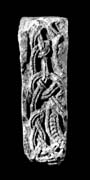
Object type: Fragment of a shaft
Measurements: H. 37 cm (14.5 in); W. c. 20 cm (8 in); D. 11.5 < 12 cm (4.5 < 4.75 in)
Stone type: Pale yellowish grey (10YR 8/2) oolitic limestone, with patchy yellow-brown (7.5YR 8/4) staining, with a calcite matrix pitted with sockets of ooliths of 0.3 to 0.6mm diameter and containing ovoid pellets 2mm long and some worn shell fragments. A calcite veinlet on one face. Bath stone
Plate numbers in printed volume: Pls. 274; 282-5
Corpus volume reference: Vol 7 p. 165-6
(There may be more views or larger images available for this item. Click on the thumbnail image to view.)
The background has been filled in with red ochre.
A (broad): Mainly chiselled flat but traces of medianincised interlace survive at one end.
B (narrow): Part of a flat-band moulding, enclosing median-incised interlace intertwined with the body of a ribbon animal. The body is double outlined, decorated with zig-zag scales, and swells from 1 cm to 3.7 cm.
C (broad): Dressed flat, longitudinal section of a dowel hole at the top (depth of dowel 8 cm).
D (narrow): Recut and redressed into broad transverse grooves.
E (top): Slopes upwards from face B to D (width of dowel hole 3 cm).
This must have been an elegant piece in which the serpentine body of the animal was intertwined with free median-incised interlace in the manner of Ramsbury 2 and 3 (Ills. 485–6, 492, 495–7), although this belongs to a group with deep and elaborately carved body patterning. This and Keynsham 5 (Ill. 287) reflect the widespread fashion for such ornament which had a longstanding popularity in Wessex (see introduction p. 42 and Fig. 19).
