Select a site alphabetically from the choices shown in the box below. Alternatively, browse sculptural examples using the Forward/Back buttons.
Chapters for this volume, along with copies of original in-text images, are available here.


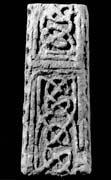
Object type: Shaft
Measurements: H. 50 cm (19.75 in); W. 20 > 16.5 cm (8.25 > 7 in); D. 12 cm (5 in)
Stone type: Yellowish grey (5Y 7/2), matrix-supported, shelly oolite. Ooliths mostly in the range 0.4 to 0.6 mm diameter, but a few up to 1.0 mm. Most ooliths weather out to give 'aero-chocolate' texture, but a few stand proud. Abraded planar shell fragments mostly up to 2.5 mm across, but a few up to 7 mm. Bath stone, Chalfield Oolite Formation, Great Oolite Group, Middle Jurassic
Plate numbers in printed volume: Pls. 272-3; 275-8
Corpus volume reference: Vol 7 p. 164-5
(There may be more views or larger images available for this item. Click on the thumbnail image to view.)
A (broad): The face is divided into two panels surrounded by double flat-band mouldings, which enclose fine stranded and widely spaced interlaced knots; the lower panel with two registers of pattern C knots, the upper with a non-geometric pattern.
B (narrow): A panel of palmette fronds in high relief, divided by a fine incised line from a plain flat panel.
C (broad): Plain and dressed
D (narrow): The same as face B save that the fronds face in the opposite direction.
E (top) and F (bottom): Dowel hole in centre, diam. 4 cm (1.5 in), depth 10 cm (4 in)
Formally this is a puzzling piece: the shaft tapers slightly so that it is reasonably interpreted as a cross-shaft, and as Cottle and Lowe have remarked (1988, 103) 'deep dowel holes on a door jamb are highly unlikely'. Yet one broad face appears to have been plain originally; on the two narrow faces the fronds face towards the only fully carved face (A), and the wide plain border edged with an incised line gives the appearance of something which was not intended to be visible. In addition the patterns are cut by the two deep dowels at the top and bottom of the shaft. It is of course possible that the dowels are secondary, but other monuments are constructed in segments. If this is a cross-shaft then it is possible that it stood in a recess in which only the carved faces were visible. On the other hand it could have been a jamb of an open entrance such as one finds at Britford (Ills. 410–24).
The palmette ornament was compared by Cottle and Lowe with fol. 3r of the Godescalc Evangelistary (AD 781–3) where both the frieze of palmettes and very similar interlace formed with linked knots and long glides occurs (Mütherich and Gaehde 1977, 24, pl. 1). Similar palmettes are also found in BL Cotton Vespasian A. I, fol. 30v (Alexander 1978, no. 29, ill. 146) and on sculpture in southern England with which this work can be compared, namely the sculptures at Britford and Codford in Wiltshire (Ills. 411–20, 428) which have been dated to the late eighth century. Nevertheless, at a much smaller scale in metalwork, a panel of rounded leaves facing in opposite directions on either side of a central line is to be found decorating the guard of a sword from Abingdon which has been dated late ninth/early tenth century (Backhouse et al. 1984, 34, ill. 14). See introduction p. 48.
