Select a site alphabetically from the choices shown in the box below. Alternatively, browse sculptural examples using the Forward/Back buttons.
Chapters for this volume, along with copies of original in-text images, are available here.


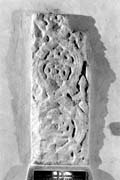
Object type: Shaft
Measurements: H. 73 cm (29 in); W. 30 > 28 cm (11.5 > 11 in); D. 19 cm (7.5 in) (after Newall 1939)
Stone type: Pale yellowish-grey (10YR 8/2) shelly oolitic limestone. Only one face of the shaft is displayed. Much of its lower half is even-grained oolite with ooliths around 0.5mm diameter, but a patch of shell detritus includes some polyzoan fragments. The upper half (perhaps due to a shelly layer intersecting the surface obliquely) is mainly shelly oolite, with rhynchonellid and polyzoan fragments. Bradford stone, Ancliff Oolite member of the Forest Marble formation, Great Oolite Group, Middle Jurassic
Plate numbers in printed volume: Pl. 452
Corpus volume reference: Vol 7 p. 217
(There may be more views or larger images available for this item. Click on the thumbnail image to view.)
Part of a single roll moulding survives to the right. Two broad, originally pelleted, bands cross to form two complete medallions (23 cm / 9 in long at the crossing points), and the beginning of a third at the top. Within each medallion there are pendant stems which sprout a pair of small pointed triangular leaves. In the upper medallion the strands appear to be knotted. In the lower medallion it appears that the trumpet node divides from the main wide stem crossing, one narrow strand passing through the upper medallion to form a knot and another crossing into the lower medallion and falling as a pendant flower. In the intersections between the medallions there are pairs of small pointed leaves.
The very broad pelleted bands which cross like medallion plant-scrolls could well be such, and with their small pointed leaves and delicate knotted tendrils they are, as Kendrick noted (in Newall 1939, 183), unique in southern England. The pelleted bands do however have the appearance of lacertine animals, and one wonders whether this is a transitional piece which includes both plants and lacertine animals, as at Colyton (Ills. 4, 7). Kendrick dated it early or mid ninth century and compared it with Carolingian manuscripts. It is however more reasonably placed in the scroll tradition, and the leaf forms are very similar to Kelston 1 (Ill. 268).
