Select a site alphabetically from the choices shown in the box below. Alternatively, browse sculptural examples using the Forward/Back buttons.
Chapters for this volume, along with copies of original in-text images, are available here.


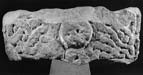
Object type: Cross-head fragment [1]
Measurements: H. 24.2 cm (9.5 in) W. 54.6 cm (21.5 in) D. 15.2 > 12.5 cm (6 > 5 in)
Stone type: Fine-grained, deltaic sandstone with well sorted, sub-angular grains. This fragment is both dirty and very weathered; yellowish brown (10YR 5/4). Stone provenance as Easington 1 (All Saints)
Plate numbers in printed volume: Ills. 213–16
Corpus volume reference: Vol 6 p. 104
(There may be more views or larger images available for this item. Click on the thumbnail image to view.)
A (broad) : The upper and lower limbs are lost, as well as the upper and lower edges. It is therefore impossible to identify the cross type. The modelled edge moulding is damaged. In the centre is a shallow domed boss. At its centre is a fix-point for its construction. The arms are filled with dense confused interlace with modelled strand and irregularly placed pellets as fillers.
B (narrow) : The worn edge moulding is modelled but survives only at the left. Within the arm-tip panel is the same clumsy interlace, with angular bends, as face A.
C (broad) : The edge moulding and boss are as face A. The left-hand limb has extremely worn, almost stopped-plait elements, not symmetrically disposed.
D (narrow) : Very worn, the edge moulding survives at the left. Within the panel are elements of clumsy, badly ordered interlace.
The piece is an amateurish copy of a typical Anglo-Scandinavian cross-head of north Yorkshire. It was carved free-hand.
