Select a site alphabetically from the choices shown in the box below. Alternatively, browse sculptural examples using the Forward/Back buttons.
Chapters for this volume, along with copies of original in-text images, are available here.


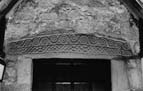
Object type: Part of hogback [1][2]
Measurements: L. 182 cm (71.7 in) W. 32 cm (12.6 in) H. 35 > 24 cm (13.8 > 9.5 in)
Stone type: Medium-grained, well sorted, slightly feldspathic, deltaic sandstone. Brownish yellow (10YR 6/6). Stone provenance as Crathorne 1 (All Saints)
Plate numbers in printed volume: Ills. 133–4
Corpus volume reference: Vol 6 p. 86
(There may be more views or larger images available for this item. Click on the thumbnail image to view.)
A (long) : A plain modelled moulding runs along the top of the fragment, below which is a well-ordered run of scroll and pellet in broad fleshy strand. Below it is a run of interlace in modelled strand with medial terminations. It consists of six elements. A long closed circuit runs the length of the panel with a simple loop. Linked into this are three closed circuits of two, four and five stages as well as two free rings. Except for the loop, all the terminations are elliptical. The panel tapers at each end. Below is a broad plain plinth.
B and D (ends) : Built in.
C (long) : As face A, but more damaged.
This is a type h hogback, the scroll variety, which is the most widespread, occurring at Repton, Derbyshire, in Cumbria, and elsewhere in Yorkshire (Lang 1984a, 101). The leafless plant-scroll and the trompe-l'oeil interlace are late derivations from the Anglian repertoire on a type of monument initiated by Anglo-Norse colonists. Compare Bedale 5 (Ill. 8), Kirby Wiske 2 (Ills. 387–8) and York, St Mary Bishophill Junior 7 (Lang 1991, 87, ills. 241–5), as well as no. 6 below.
[1] The following are general references to the Crathorne stones: Bulmer 1890, 118; Hodges 1894, 195; Allen 1895, 148; Morris, J. 1904, 420; Collingwood 1908, 120; Page, W. 1923, 236 fn, 237; Morris, J. 1931, 417; Morris, C. 1976a, 141; Brown, M. 1979, 41; Lang 1984a, 87.
[2] The following is an unpublished manuscript reference to no. 4: BL Add. MS 37552 no. XIV, item 526 (Romilly Allen collection).
