Select a site alphabetically from the choices shown in the box below. Alternatively, browse sculptural examples using the Forward/Back buttons.
Chapters for this volume, along with copies of original in-text images, are available here.


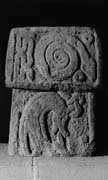
Object type: Shaft fragment [1] [2]
Measurements: H. 33.5 cm (13.2 in) W. (collar) 25 > 24 cm (9.9 > 9.5 in); (shaft) 22.5 > 21.5 cm (8.9 > 8.5 in) D. (collar) 20.5 > 19 cm (8.1 > 7.5 in); (shaft) 18.5 > 17.5 cm (7.3 > 6.9 in)
Stone type: Fine-grained, well sorted sandstone with sub-angular grains. Yellowish brown (10YR 5/4) with prominent limonite vein (dark brown, 10YR 3/3). Deltaic sandstone from the Saltwick Formation, Aalenian, Middle Jurassic. Certainly from the Cleveland Hills escarpment, possibly from the vicinity of the pre-Roman regalis via track above Swainby
Plate numbers in printed volume: Ills. 129–32
Corpus volume reference: Vol 6 p. 84-85
(There may be more views or larger images available for this item. Click on the thumbnail image to view.)
Part of a collared shaft.
A (broad) : A plain edge moulding frames the collar panel which is stepped out from the shaft below. In the left of the panel is a small section of meander pattern in relief. The rest of the panel is filled with a tightly coiled serpent which terminates at the bottom right-hand corner in a head with bulging eyes, viewed from above. There is a pellet filler with a central drilled hole just below the head, and its twin occupies the upper right-hand corner. Below the collar, only the upper portion of the shaft survives. The panel is framed by a plain edge moulding on the vertical sides enclosing a dragon-like beast. Its neck is arched against the top of the panel and its head faces down; its body is outlined by incised edge mouldings which also form a collar. The beast has a long snout with a drilled eye, the mouth is open, and either a large fleshy tongue or thick strand protrudes from the mouth. An ear lappet or horn extends above the head into the upper right-hand corner and forms a knot. On its left-hand side a long, thin wing runs down behind the beast's back. Collingwood'shows this with incised diagonal lines which can no longer be seen. The lower half of the animal, including its lower limbs, is missing. A pellet fills the bottom right-hand corner.
B (narrow) : A plain edge moulding frames the collar panel. The panel is filled by a pattern B knot, median-incised. The pattern is very regular with deep hole-points and the strand is modelled. There is a pellet filler at the bottom left-hand side. Below the collar the panel is framed by a plain edge moulding on the two vertical sides. The shaft is filled by a crude ring-chain, median-incised. The upper link survives and is pierced by a looping strand, the lower portion of which is missing. A pellet filler is placed in the centre of the upper link, and there is another on the right-hand side at the junction between the upper and lower loops.
C (broad) : The collar panel is as face B. Below, a plain edge moulding runs down the two vertical sides. Immediately below the collar is the flattened head of a broad, winged figure. The face is wedge-shaped with a forked, pointed beard. The eyes and mouth are formed by oval drilled holes, while the nose is indicated by an incised curved line. There are no indications of hair or a halo. Extended wings curve out from either side of the body. They are shown naturalistically with the four feathers of each wing depicted by vertical incised lines. The torso is indicated only by two thick horizontal bars, flanked by the arms on either side. The lower part of the body is missing.
D (narrow) : The collar panel is as face B. Below, the shaft has a plain edge moulding on the two vertical sides. The panel is filled by a closed circuit interlace, type A, with concentric rings and long glides. The strand is single and broad and the pattern is well executed.
The close-meshed broad-stranded interlace on three faces of the collar, and the ring knot on face D, indicate a relatively late date for this piece, but there is some evidence for the inspiration of earlier models in the long-necked beast with tongue and ear extensions into interlace. This is a distant reminiscence of the fanciful creatures on the lowest tier of the Masham column (Ills. 625–31). The fragments of motifs on the collar of this face are best placed within a Viking-age context, and the coiled serpent with head viewed from above may be paralleled on a cross-shaft from Lastingham (Lang 1991, ill. 574) as well as Forcett and Gilling West in this region (Ills. 251, 267). The strange winged figure on face C may be derived from an image of an angel, or an Evangelist symbol of St Matthew, but the flat treatment of the figure and the binding across the body are typical of the Viking Age (compare Leeds: Collingwood 1915, 217). It is possible that there was meant to be an opposition of good and evil on the two broad faces of the cross, with the angel on one face and the serpent and dragon on the other, an opposition which is also found at Brompton (Ills. 37, 39).
[1] The following are general references to the Crathorne stones: Bulmer 1890, 118; Hodges 1894, 195; Allen 1895, 148; Morris, J. 1904, 420; Collingwood 1908, 120; Page, W. 1923, 236 fn, 237; Morris, J. 1931, 417; Morris, C. 1976a, 141; Brown, M. 1979, 41; Lang 1984a, 87.
[2] The following is an unpublished manuscript reference to no. 1: BL Add. MS 37552 no. XIV, items 522–3 (Romilly Allen collection).
