Select a site alphabetically from the choices shown in the box below. Alternatively, browse sculptural examples using the Forward/Back buttons.
Chapters for this volume, along with copies of original in-text images, are available here.


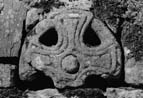
Object type: Cross-head
Measurements: H. 30 cm (11.8 in) W. 38 cm (15 in) D. 14 cm (5.5 in)
Stone type: Coarse-grained, feldspathic, gritstone with pebbles up to 20mm in size. The colour is difficult to determine because the cross-head is covered with lichen and algae, but probably very pale brown (10YR 7/3–4). Typical representative of the Red Scar Grit (Millstone Grit, Namurian, Upper Carboniferous), which caps the Pennine hills to the west of Coverham (e.g. as quarried at nearby Pen Hill).
Plate numbers in printed volume: Ill. 126
Corpus volume reference: Vol 6 p. 83-84
(There may be more views or larger images available for this item. Click on the thumbnail image to view.)
A ring-headed cross, type (b).
A (broad) : The wheel is recessed from the face of the cross. The cross is of type E10 with rounded arm-pits and splayed arms. There is a plain double roll moulding bordering the cross, both strands narrow. At the centre of the cross is a protruding convex boss. The face of the cross is plain. The wheel may have had an edge moulding but it is very worn.
B–E: Built in.
Plain ring-headed crosses are fairly common in the region: for example, Lythe 8 (Ills. 493–7) and Sockburn 12, co. Durham (Cramp 1984, pl. 140, 749–50), though their lack of ornament renders dating difficult. A close parallel is Topcliffe 1 (Ills. 814–18).
