Select a site alphabetically from the choices shown in the box below. Alternatively, browse sculptural examples using the Forward/Back buttons.
Chapters for this volume, along with copies of original in-text images, are available here.


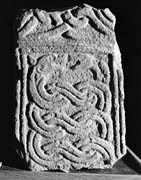
Object type: Cross-shaft
Measurements: H. 46.5 cm (18.3 in) W. 31.5 > 28 cm (12.4 > 11 in) D. 19.5 cm (7.7 in)
Stone type: Hard fine-grained deltaic sandstone, with well sorted fabric. Light grey (2.5YR 7/2). Deltaic sandstone (possibly Brigantian, Lower Carboniferous) from the cyclotherms exposed in the Cotherstone area of Teesdale
Plate numbers in printed volume: Ills. 119–24
Corpus volume reference: Vol 6 p. 82
(There may be more views or larger images available for this item. Click on the thumbnail image to view.)
The upper portion of a shaft, with what seems to be part of the head. There are prominent roll mouldings at the edges which enclose panels surrounded by finer roll mouldings on each face. Above the main panel is a horizontal double roll moulding enclosing the remains of a bold knot with pointed terminals.
A (broad) : At the top of the lower panel are two confronted beasts with canine heads, pricked up ears and gaping jaws. Their serpentine bodies, which are median incised, are intertwined in a series of double twists with wide spacing in between.
C (broad) : At the top, the terminal of a four strand knot; below, a panel of turned pattern A interlace.
D (narrow) : An animal of the same type as on face B but with a shorter muzzle and with the interlaced body more crudely carved. There is a space by the muzzle of the creature as though another head may have been intended.
The workmanship of this piece is curiously uneven in quality. Face A is carved with assurance and delicacy, with well-smoothed surfaces between the twisted strands. On the other faces the strands are thick and close packed. The 'ladder twist' on face A appears to be a regional motif since it is closely paralleled at Stanwick (Ills. 754, 758) and less closely at North Otterington (Ill. 697). In neither case however does the pattern terminate in animal heads. The Cotherstone heads on this face (in particular that on the left) are of a different type from those on the sides. The creature on the left with sharply pricked ear, bumpy forehead and snapping jaws, and with a scroll detail on its jaw, is reminiscent of late eighth- to early ninth-century metalwork (Webster and Backhouse 1991, ills. 184 and 187a–f). The heads of the creatures on faces B and D are however more like those on the Bamburgh chair arm, Northumberland (Cramp 1984, pl. 158, 814), although there the creatures have crossed paws and interlaced tails in a manner closer to manuscript beasts. On the whole this seems to be a transitional piece, and indeed possibly one which was started by one carver and finished by others.
