Select a site alphabetically from the choices shown in the box below. Alternatively, browse sculptural examples using the Forward/Back buttons.
Chapters for this volume, along with copies of original in-text images, are available here.


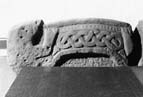
Object type: Part of hogback [1][2]
Measurements: L. 59.2 cm (23.3 in) W. 22.9 cm (9 in) H. (crown) 43.2 cm (17 in); (end) 38.1 cm (15 in)
Stone type: As no. 9. Bedding planes can be seen running obliquely through the stone in end view. Small holes can be seen where small limonite concretions have been eroded away.
Plate numbers in printed volume: Ills. 79–81
Corpus volume reference: Vol 6 p. 73-74
(There may be more views or larger images available for this item. Click on the thumbnail image to view.)
The decoration is identical on each side.
A (long) : A plain, flat ridge issues from the end-beast's jowl. Below it is a strip of pellets flanked by two plain mouldings, following the curve of the roof. Below is a broad panel of closed circuit twist in flat strand, threaded by a free strand with arrow-head terminals at each end that fill the spandrels of the shallow arch of a recessed niche. This niche is flat-topped and edged with a flat moulding. Within the niche the surface retains rough chisel marks.
The end-beast is fairly naturalistic and muzzled. The jowl has an abrupt snout, incised circular eyes on top, along with pointed ears in plain moulding. The forelegs have distinct elbows and the paws four toes touching the ridge. Only the paws of the lost end-beast survive.
C (long) : As face A.
This is a type d (extended niche) hogback, but it is distinguished from other examples at Brompton and Sockburn by its more substantial end-beasts and the unique free strand in the interlace with arrow-head terminals. It is possible that the latter were intended as zoomorphic heads which might be compared with Hovingham 1 (Lang 1991, 144–5, ill. 486–9), but similar arrow-head terminals have recently been recognised on the Cranwell 2 hogback in Lincolnshire (Everson and Stocker 1999, 138). The pellet strip is also a unique feature on a hogback. This stone may be a transition from type c.
[1]The following are general references to the Brompton stones: (—) 1867–8, lxxxviii; Rowe 1870, 240; (—) 1871–2, xxiv; Greenwell 1869–79a, lx; Rowe 1877, 61–4; Allen and Browne 1885, 352; Browne 1885–6, 124, 128; Saywell 1886, 481; Allen 1887, 126, 386, fig. 28; (—) 1890–5a, viii; Haverfield and Greenwell 1899, 125–6; Bulmer 1890, 389; Hodges 1894, 195; Morris, J. 1904, 32, 84–5, 420; Bogg 1908, 28–32, ills. on 29 and 32; Page, W. 1914, 430, 431; Morris, J. 1931, 33, 86, 87, 417; Elgee and Elgee 1933, 219–20, 245; Mee 1941, 41–2; Fisher 1959, 89; Pevsner 1966, 90, pl. 8; Bailey 1980, 85, 100, 240, 252, 255, 265; Kerr and Kerr 1982, 38–9 and ill.; Morris, R. 1983, 7; Cramp 1984, 11, 30, 93; Bailey and Cramp 1988, 54; Lang 1988a, 14, 24, 56; Cambridge 1989, 378; Richards 1991, 80, 119, 124, ill. 81; Everson and Stocker 1999, 138; Stocker 2000, 205–6.
[2] The following are general references to the Brompton hogbacks (in addition to the note on p. 65): Walker 1884–5, 420; Allen 1889, 230
