Select a site alphabetically from the choices shown in the box below. Alternatively, browse sculptural examples using the Forward/Back buttons.
Chapters for this volume, along with copies of original in-text images, are available here.


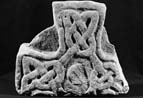
Object type: Part of cross-head [1]
Measurements: H. 34 cm (13.4 in) W. 41.4 cm (16.3 in) D. 13 cm (5.1 in)
Stone type: As Brompton In Allertonshire 9 (St Thomas)
Plate numbers in printed volume: Ills. 58–61
Corpus volume reference: Vol 6 p. 71
(There may be more views or larger images available for this item. Click on the thumbnail image to view.)
A plate-head cross of type B 10, with the disc recessed.
A (broad) : The end of the right-hand arm is lost. The plain perimeter moulding is broader at the top of the upper limb. Each arm contains a 'Brompton loop' in modelled strand. A central boss is damaged.
B (narrow) : Damaged.
C (broad) : As face A. The boss is damaged.
D (narrow) : Within a plain perimeter frame the arm-tip has closed circuit pattern B interlace of four stages. The hole-points are gridded at 1.5 inch distances. The top of the plate-head disc may have had interlace; it is now very worn.
E (top) : Very weathered.
This is one of a fairly large group of plate-heads within the Brompton school, with examples at Kirklevington and Sockburn as well as Northallerton and Brompton (see Chap. VI, pp. 47–9). Bailey's template analysis on the arm-pit curve showed that many came from a single workshop, though others are freehand copies in terms of the 'Brompton loop' interlace of the cross face (Bailey 1978b, 183). Indeed, no. 11 was not gridded, though it is more orderly than the similar head of no. 1, where the boss is not central. The plate gives stability to the most vulnerable part of the cross during cutting and is the mark of a cautious sculptor. There are Irish examples, but they are not as frequent as in Allertonshire. The plate is contemporary with the ring.
