Select a site alphabetically from the choices shown in the box below. Alternatively, browse sculptural examples using the Forward/Back buttons.
Chapters for this volume, along with copies of original in-text images, are available here.


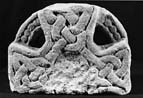
Object type: Cross-head [1]
Measurements: H. 28.5 cm (11.2 in) W. 38 cm (15 in) D. 18.2 cm (7.2 in)
Stone type: Fine-grained deltaic sandstone, slightly micaceous and feldspathic. Yellow (10YR 7/6). Stone provenance as Brompton In Allertonshire 1 (St Thomas).
Plate numbers in printed volume: Ills. 51–4
Corpus volume reference: Vol 6 p. 70
(There may be more views or larger images available for this item. Click on the thumbnail image to view.)
A (broad): A wheel-head of ring type (b); the wheel is recessed and has pellet moulding between flanking plain mouldings. The arm-pits are angular and the arms have straight edges. The cross-head has a narrow perimeter edge moulding (0.75 inch). Each arm is filled with a 'Brompton loop', connected to the next by a continuing stand. The central boss is hacked away.
B (narrow): Damaged and covered with mortar. The wheel has faint traces of plain edge mouldings for each face.
C (broad): As face A for the wheel, with four pellets in the moulding strip. The rest of the surface is covered with mortar.
D (narrow): The arm-tip has a plain rectangular frame containing an oval laced by two strands cross-wise, with three pellets along the top.
E (top): Very weathered.
Despite the proven template links between several crosses from Brompton and its neighbourhood (Bailey 1978b, 183, figs. 9.10, 9.11), there is considerable variety within the Brompton school (see Chap. VI, pp. 47–9), much of it owing to the range of quality in the cutting. Nos. 9 and 10 are the most assured and stand apart from the rest of the series at the site. They are the only ring-heads from Brompton with pierced arm-pits, and they represent both types of ring: no. 9 is ring (b) and no. 10 is ring (a). Both have a pelleted ring, unlike the other heads from the church. The 'Brompton loop' (Fig. 12, p. 47) is held in common with many other crosses in the school, and here there is evidence of it being constructed on a diagonal grid. Ring-head crosses are a tenth-century phenomenon in this region, post 920 (Bailey 1978b, 178–9), introduced from the Celtic west. The use of pellets and simple ring-knots (face D) is typical of Anglo-Scandinavian ornament in north Yorkshire generally. These two ring-heads have no close parallels at neighbouring sites.
