Select a site alphabetically from the choices shown in the box below. Alternatively, browse sculptural examples using the Forward/Back buttons.
Chapters for this volume, along with copies of original in-text images, are available here.


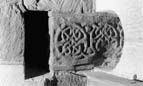
Object type: Impost [1]
Measurements: L. 62 cm (24.4 in) H. 26.4 cm (10.4 in) D. 35.5 cm (14 in)
Stone type: As Kirby Hill 1 (All Saints, Kirkby-on-the-Moor)
Plate numbers in printed volume: Fig. 16; Ills. 369–71
Corpus volume reference: Vol 6 p. 134-135
(There may be more views or larger images available for this item. Click on the thumbnail image to view.)
A (broad, south) : The edge moulding is worn and encloses a panel containing three registers of encircled pattern D interlace in thin modelled strand. Single pellet fillers are inserted within the spandrels between one register and the next. The loose strands merge into the corners of the panel.
D (narrow, west) : The perimeter moulding, double at the top, is modelled and contains a panel with two registers of plant-scroll. The left-hand scroll is damaged but has shootlets extending beyond the roundel. Between the scrolls is a node from which spring the scroll stems on either side of an upright stem crowned with a worn berry or bud. The right-hand scroll contains a triangular feature which was either a berry bunch or a triangular split leaf. A pair of shootlets extend into the corners of the panel. The stem is well modelled and the cutting is deep.
This carefully carved and decorative impost indicates an important church on the site in the late eighth century. There is a nearby parallel built into Ripon Minster (Ill. 1197; Collingwood 1915, 233–5, fig. e), to which Kirby Hill may have been attached. The place clearly continued as a cemetery site through to the Viking Age.
[1] The following are general references to the Kirby Hill stones: Lunn [1867], 13; Allen and Browne 1885, 353; Allen 1890, 293; Bulmer 1890, 734; Hodges 1894, 195, 201; Morris, J. 1904, 212, 420; Thompson 1908, 113; Stapleton 1923, 7, 10, 53; Morris, J. 1931, 212, 417; Pontefract and Hartley [1936], 126; Mee 1941, 125; Taylor and Taylor 1965, I, 355; Pevsner 1966, 210; Morris, R. 1989, 161; Muir 1997, 96–7.
[2] The following is an unpublished manuscript reference to no. 12: BL Add. MS 37554 no. XVI, items 82–3 (Romilly Allen collection).
