Select a site alphabetically from the choices shown in the box below. Alternatively, browse sculptural examples using the Forward/Back buttons.
Chapters for this volume, along with copies of original in-text images, are available here.


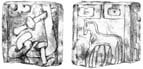
Object type: Part of grave-marker [1] [2]
Measurements: after Rowe 1870) H. 25.4 cm (10 in) W. 25.4 cm (10 in) D. 12.7 cm (5 in)
Stone type: Unobtainable
Plate numbers in printed volume: Fig. 15; Ills. 358–9
Corpus volume reference: Vol 6 p. 133
(There may be more views or larger images available for this item. Click on the thumbnail image to view.)
(After Rowe's illustration.)
A (broad) : A plain edge moulding flanks a panel containing an L-shaped ribbon dragon whose body is pierced by a sword, complete with hilts. The lower extremities of the creature are bound by rough loops. In the upper left corner the base of a strand splits into a pair of volutes.
B (narrow) : Not recorded.
C (broad) : A plain edge moulding flanks a panel, at the top of which is a pair of rectangles each containing a smaller rectangle and a central dot. Below this is a horse, shown in profile facing left with a double outline.
D (narrow) : A run of step pattern.
This may have been part of a larger cross, as Rowe suggested. Its iconography supplements that of no. 2 above and belongs to the Sigurðr story. The horse of face C may be Grani and is paralleled at Halton, Lancashire (Collingwood 1927a, 159–60, fig. 191), and York Minster 34 (Lang 1991, 71–2, ills. 145, 147). The pierced dragon is Fáfnir, the knots of the torso being a feature of York Minster 34. The Northumbrian and Manx carvings usually show Sigurðr holding the sword up beneath the dragon, though there is a close parallel in an incised carving from Tanberg, Buskerud, Norway and a Viking-age axe from Vladimir-Susdal, Russia, where the sword is shown in the manner of Kirby Hill 9 (Ploss 1966, 64, pls. 7a–b, 25). The Scandinavian connection is very strong.
[1] The following are general references to the Kirby Hill stones: Lunn [1867], 13; Allen and Browne 1885, 353; Allen 1890, 293; Bulmer 1890, 734; Hodges 1894, 195, 201; Morris, J. 1904, 212, 420; Thompson 1908, 113; Stapleton 1923, 7, 10, 53; Morris, J. 1931, 212, 417; Pontefract and Hartley [1936], 126; Mee 1941, 125; Taylor and Taylor 1965, I, 355; Pevsner 1966, 210; Morris, R. 1989, 161; Muir 1997, 96–7.
[2] The following is an unpublished manuscript reference to no. 9: BL Add. MS 37552 no. XIV, item 631 (Romilly Allen collection).
