Select a site alphabetically from the choices shown in the box below. Alternatively, browse sculptural examples using the Forward/Back buttons.
Chapters for this volume, along with copies of original in-text images, are available here.


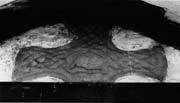
Object type: Cross-head
Measurements: H. 58.5 cm (23 in); W. 56.5 cm (22.25 in); D. Built in
Stone type: Medium-grained, feldspathic, yellow (10YR 7/6) sandstone; deltaic channel sandstone, Saltwick Formation, Aalenian, Middle Jurassic; perhaps from Aislaby, near Whitby (see Fig. 5)
Plate numbers in printed volume: 665
Corpus volume reference: Vol 3 p. 179-180
(There may be more views or larger images available for this item. Click on the thumbnail image to view.)
Only one face is visible.
A (broad): All four arms of a type E10 free-armed cross-head survive. The arm-pits are wide curves, except for the lower left, which inclines to type 11.
A gently modelled plain edge moulding frames the entire face. In the centre are the remains of a domed boss, now chipped off. The arms are filled by a continuous plain plait with widely meshed strands. The lower arm has a shorter run, the strands being caught up in a simple twist below the boss. The strands are neatly cut and modelled.
The continuation of the edge moulding across the end of the lower arm casts some doubt on the fragment's definitely being the head of a free-standing cross, though its extraction from the wall would solve the problem. It is possible that this is an architectural embellishment, of similar function to the cross panels at Hovingham (no. 4; Ill. 484) and Middleton (no. 9; Ill. 694). The interlace is competently constructed, the individuality of the lower arm's pattern not being disturbing. Collingwood dated it AC, and Pevsner attributes it to the eleventh century. In view of the survival of Anglian taste in Yorkshire throughout the Scandinavian period, there is little need to exclude the piece from the tenth century. The diversity of shape in the cross-arms is perhaps confusing: the left (type 11) is similar to many Anglo-Scandinavian crosses of the tenth century, whilst the right arm is common in the western part of the North Riding at the same period. The openness of the interlace strands suggests an inclination to the late ninth century rather than the early eleventh.
