Select a site alphabetically from the choices shown in the box below. Alternatively, browse sculptural examples using the Forward/Back buttons.
Chapters for this volume, along with copies of original in-text images, are available here.


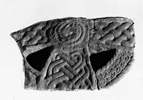
Object type: Lower part of cross-head
Measurements: H. 35 cm (13.8 in); W. 54 cm (21.25 in); D. Built in
Stone type: Medium-grained red sandstone (St Bees sandstone)
Plate numbers in printed volume: 309 - 10
Corpus volume reference: Vol 2 p. 104
(There may be more views or larger images available for this item. Click on the thumbnail image to view.)
Cross-head, type B6, with ring, type 1a. Only face A is now visible; the Description of face C is based upon the (re-touched?) plate published in Calverley 1899a.
A (broad): The ornament on the arms is bordered by a roll moulding; on the arcs of the circle the border moulding is cabled. At the centre is a flat boss surrounded by a cabled ring. The two lateral arms are decorated with a four-strand plain plait and there is a similar plait in the lower arm where, however, the strands are double, with holes drilled at the intersections. On the one visible arc of the ring there is a delicate ring-chain ornament using double strands similar to those on the lower arm.
C (broad): Calverley's photograph shows that the border mouldings were identical to those on the other face. At the centre was an encircled boss with plain plait in the lateral arms, four-strand to the left and three-strand to the right. The lower arm was decorated with four-strand plain plait using strands of similar type to those on the equivalent arm of the other face. The ring carried three-strand plain plait.
This very large cross-head must have belonged to a very impressive carving. Symptomatic of this is the presence of decoration on the ring, for this only occurs on some six Northumbrian sculptures – and three of them are at Gosforth. Parker (1896, 72) rightly drew attention to the resemblance between the plait on the lower arm of face A and that on the north side of the main Gosforth cross. The fleshy plait of the horizontal arms is similarly closely paralleled among the other works of the Gosforth master whilst the incredibly delicate ring-chain is a miniature version of a motif heavily exploited on the main cross. This cross-head is thus best dated, like Gosforth 1, to the early part of the tenth century and can be attributed to the Gosforth master (Bailey and Lang 1975).
