Select a site alphabetically from the choices shown in the box below. Alternatively, browse sculptural examples using the Forward/Back buttons.
Chapters for this volume, along with copies of original in-text images, are available here.


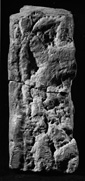
Object type: Part of cross-shaft
Measurements: H. 48 cm (19 in); W. 26 > 24 cm (10.2 > 9.5 in); D. 17.5 in (7 in)
Stone type: Medium-grained red sandstone (St Bees sandstone?)
Plate numbers in printed volume: 284 - 7
Corpus volume reference: Vol 2 p. 99-100
(There may be more views or larger images available for this item. Click on the thumbnail image to view.)
A? (broad): Two parallel rows of T-pattern, meander type 2, bordered by a roll moulding shared with face B.
B? (narrow): Traces of a contoured ribbon animal bound in interlace. Collingwood's drawing suggests the presence of a ring-binding across the beast's neck, but this is now no longer clear.
C? (broad): Recut.
D? (narrow): Traces of relief decoration (ribbon animal bound in interlace?).
Though worn, the animal ornament on face A is clearly of Insular aellinge type; the ring binding, if such ever existed, is paralleled at Nunburnholme, Yorkshire, and on Kirkby Stephen 1 and, among the minor arts, on a tenth-century casket in the British Museum (Lang 1976b; Wilson 1964, no. 154). The double row of T-patterns reflects a general north-western taste for parallel strips of ornament and is matched exactly at Chester and on three carvings from north Wales, all of which have other links to Cumbria (Allen 1892–5, 155; Nash-Williams 1950, nos. 1, 38, 190).
