Select a site alphabetically from the choices shown in the box below. Alternatively, browse sculptural examples using the Forward/Back buttons.
Chapters for this volume, along with copies of original in-text images, are available here.


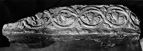
Object type: Architectural feature (the 'Bow Stone')
Measurements: L. 74 cm (29 in); W. 45.5 cm (17.75 in); D. 35.5 cm (14 in)
Stone type: Medium-grained yellow sandstone (Carboniferous?)
Plate numbers in printed volume: 277 - 80
Corpus volume reference: Vol 2 p. 97-98
(There may be more views or larger images available for this item. Click on the thumbnail image to view.)
Only one face is carved in high relief.
A (broad): The remains of three complete and three incomplete medallions of a crossing scroll framed by mutilated flat-band mouldings. Reading from left to right: (i) only part of the lower strand of the medallion and a leaf of indeterminate type on a short stem curls back to fill the lower spandrel between the crossing. (ii) The upper strand of the medallion is missing but it conforms clearly to the same type as (iii), (iv) and (v), in that a thick inner strand terminates in a short triangular leaf and coiled tendril, whilst hanging from it in the centre is a short triangular berry bunch and below this, to the right, is a curling leaf with deeply cut veins. The veins on the left hand leaf in (i) are so deeply cut that they appear almost serrated whilst in (iv) the leaves are of the same plain curling type as also occur filling the spandrels of the medallions.
B (narrow): A sword, with a rounded top to the pommel and down-curving quillons, is incised over the rough quarry dressing of this face. This face has been severely damaged by the gate fittings of the tertiary use of the stone.
C (broad): Smooth, but damaged by the gate fitting; a roughly-incised long stemmed cross (G.I., fig. 2, type A1) was first noted by Hope (1906).
D (narrow): Rough dressed and cut away.
Since Falstead is the site of a small Roman station and other Roman stone fragments, including parts of grape bunches, have been found in the site, the earliest interpreter, Ferguson, thought that this piece was Roman likewise. Collingwood (1905a) was the first person to link this piece – 'the Bow Stone' with the trough from Dalston, and to decide that their stylistic similarity was so striking that they may have come from the same building. He followed up the earlier traditions of a church and burial mound at Kirksteads and noted the remains of a building near to Cobble Hall (Collingwood 1905a, 211–12). In addition he illustrated some Roman sculpture from the site, including elements of a vine-scroll. The indisputable superiority of these Roman pieces over the trough and 'Bow' stone lead him to conclude that some time later – either in the eighth or eleventh to early twelfth centuries – this Roman sculpture served as a model for the weak and wavering scrolls here under discussion. Of course Roman carvings could have been ineptly copied at any later date and the eleventh century cannot be ruled out as a possible period for production. The eighth century can be. There is no work of comparable type, either in style of cutting or the plant elements, which has survived from the pre-Conquest period in Cumbria, or even Northumbria. The use of a drill as well as a chisel; the form of the scroll in which the medallions cross but do not interlace; and the manner in which the tendrils are depicted as hooked coils, as well as the obvious attempt to depict true vine-leaves, are all unusual features in Anglian work. It is true that it is difficult to find close Roman parallels, but a sub-Roman date is at least possible in a region where Christianity traditionally survived. The reuse of the stone to form a medieval gravestone can only be dated from the shape of the sword, which could be fourteenth to fifteenth century ((—) 1967, pl. III). It seems reasonable, in view of the layout of the scroll, to see this as having been set horizontally as a lintel, as Collingwood'suggested (Collingwood 1905a, 208) and in view of the cross on the opposite face, it could have framed an opening in a Christian building. The Dalston trough could be seen as part of the same building, either serving as a trough (possibly in a baptistery) or less likely, if originally solid, as framing another opening.
