Select a site alphabetically from the choices shown in the box below. Alternatively, browse sculptural examples using the Forward/Back buttons.
Chapters for this volume, along with copies of original in-text images, are available here.


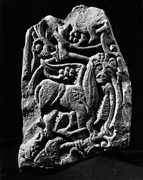
Object type: Part of cross-shaft [1]
Measurements: H. 38 cm (15 in); W. 25.5 > 24 cm (10 > 9.5 in); D. 14 cm (5.5 in)
Stone type: Medium-grained red sandstone (Penrith sandstone)
Plate numbers in printed volume: 235 - 9
Corpus volume reference: Vol 2 p. 90-91
(There may be more views or larger images available for this item. Click on the thumbnail image to view.)
The mouldings on the edges of the shaft are badly damaged. Where they survive they seem to be of the broad, flat-band type. Bailey (1974a, ii, 97) considered that it might have been the upper part of a round-shaft derivative (G.I., fig. 1g). The carving on all faces is remarkably deep and bold.
A (broad): One complete and two incomplete volutes of an inhabited scroll in which the simple volutes are embellished with a profusion of leaves and flower sprays. In the surviving portion of the uppermost volute are two pairs of human feet; those on the right are shown in profile with the heels slightly lifted as though in movement. The legs are crossed over one of the scroll strands and the toes are lightly poised on the strand below. The other feet are shown en face on the triangular node of the main volute below the other on a side tendril. One rosette berry bunch appears between the two pairs of feet and there is a triangular veined leaf on the left. The volute below is filled with a large lion-like winged creature. The claws of his front feet clasp the main volute strand and straddle two plant sprays. His head with its long neck projects over the volute at the top. His mane is heavily marked so as to appear almost horn-like; his ears are large and rounded. He has large back-pointed eyes with round pupils deeply incised and a long drooping moustache. His tail is curled under his back haunches and terminates in a plant-like plume just below a rosette berry bunch whose stem follows the line of his wings. What seems to be his other wing droops from below his chin and is partially covered by a large serrated leaf. (The other leaves which spring from the volute encircling him are similarly of the serrated type.) Below one of his back feet the head and part of the body of a serpent emerges from the scroll. Its scales are clearly marked, its eyes are round with deeply incised pupils and its head slithers naturalistically over the strands of the volute.
B (narrow): This face is split off at the top. Above a key pattern, type not determinable, which is attached by two strands to a spiral scroll, two volutes of which survive. Each volute is filled by a rosette berry bunch and there is a serrated leaf hanging from the uppermost volute.
C (broad): At the top are the remains of a quadruped of indeterminate type. It is shown realistically in the act of climbing up the scroll, one back leg braced on the volute below, the other lifted up in the scroll above. Its facial type and front legs are difficult to make out but it appears to have had eyes of a similar type to the 'lion' on face A. Between its legs is a serrated leaf with a tightly coiled stem. The volute below is filled with a large four-petalled flower with a centre rosette of corona and stamens. The outer petals are naturalistically indented and the centre is boldly projecting; spaces between the petals and the surrounding strand are filled by large pellets and at the volute junction there is a tightly coiled, split leaf.
D (narrow): The upper portion of this face is broken away below part of a straight line key pattern which develops into a plant scroll. The junction between the key and the volute below is filled by a rosette berry bunch framed by a pair of split leaves. A large serrated leaf at the bottom right belongs to the now lost scroll below.
The very deep, bold style of carving of this cross fragment separates it from the fine wiry scrolls of the Lowther group, although the berry bunches on face D are not unlike the fragment from Lowther 3.
The inhabited scrolls on faces A and C are, as Kendrick noted, the result of some 'potent extraneous influence' on the northern scrolls (Kendrick 1938, 200). I have elsewhere discussed what seems to be a wave of orientalizing influence on English sculpture of the last quarter of the eighth century to the first quarter of the ninth century, and the fantastic lion at Dacre with its leaf-like tail could be seen as a northern equivalent of a lion from Breedon (Cramp 1977a, 207). The same large fantastic beasts are also found at Otley, Yorkshire. At Breedon also there are human figures alongside fantastic birds and beasts in the scrolls, and this combination is likewise found at Hoddom (Ill. 677) and in a different form on Urswick 1. Bailey also sees the human face given to the beast as a southern mannerism (Bailey 1974a, I, 40).
It is difficult to decide what is the most convincing explanation for these human figures enmeshed in scrolls. If one accepts the proposition put forward by Bailey, that here and at Urswick (no. 1) the figures could represent the chain of being in the cosmic tree (Bailey 1974a, I, 44–5), then one has to see the other scroll inhabitants as meaningfully representative. This is easier to contemplate at Urswick, where the scroll is more complete. This western group of crosses with paired human figures must have had some special significance to their contemporaries but it is difficult to be certain what it was (Cramp 1959–60, 16). At Rothbury 1, Northumberland, there are the same jungly scrolls which enclose a striding lion, as at Dacre, and also serpentine creatures, but the details of the scrolls and their inhabitants are not closely similar. One can point to an identical taste for exotic beasts but Dacre is not closely similar to any other inhabited scroll. The little plumes of split leaves can be paralleled on Workington 1 and there is also a much later piece from Whitehaven with similar plant forms, but the built up centre of the large flower on face A (which is only paralleled elsewhere at Hexham) argues for a good Classical model. The way in which the scrolls change into straight line patterns on the narrow sides of this cross may be, as Kendrick noted (Kendrick 1938, 206) a period fashion. It is a stylistic trick which also occurs in Yorkshire, for example, on Ilkley (Collingwood 1927a, fig. 63) and in Anglo-Scandinavian art at Leeds (Collingwood 1927a, fig. 193). The inspiration for the alternation of interlace and fret patterns may have been derived from contemporary manuscripts.
