Select a site alphabetically from the choices shown in the box below. Alternatively, browse sculptural examples using the Forward/Back buttons.
Chapters for this volume, along with copies of original in-text images, are available here.


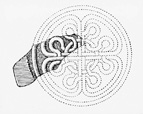
Object type: Architectural fragment(?)
Measurements: measurements (after (—) 1925) H. 23 cm (9 in) W. 9.5 cm (3.75 in)
Stone type: Unobtainable
Plate numbers in printed volume: 610
Corpus volume reference: Vol 2 p. 164
(There may be more views or larger images available for this item. Click on the thumbnail image to view.)
Only one face is recorded as carrying decoration. Collingwood's drawing shows interlace bordered by a curved moulding. Below the moulding is an undecorated border and part of the curving edge of the fragment.
Appendix A item (stones dating from Saxo-Norman overlap period or of uncertain date).
As Collingwood's drawing suggests, the carving can best be reconstructed as a circular architectural ornament whose interlace was arranged in a cruciform shape. Functionally it can therefore be grouped with the architectural roundels at Edenham, Lincolnshire, and Barnack, Northamptonshire, where other kinds of decoration are also set in a cruciform pattern (Taylor and Taylor 1963b; Cramp 1972, pl. 67). The intersecting circles with foliate motifs on a fragment from Hackness provide a Northumbrian analogue, though the shape of the latter carving and its ornamental vocabulary are quite distinct (Winterbotham 1982).
The closest parallel for the interlace composition elsewhere in the north is on the Yorkshire cross-base at Walton (Collingwood 1927a, fig. 65) though the open loops at Bromfield, if accurately represented in the drawing, seem to be unique in northern sculpture. It is, however, possible that they formed a loose version of the Borre-style knot seen on carvings like St Mary Castlegate, York (Collingwood 1927a, fig. 148).
