Select a site alphabetically from the choices shown in the box below. Alternatively, browse sculptural examples using the Forward/Back buttons.
Chapters for this volume, along with copies of original in-text images, are available here.


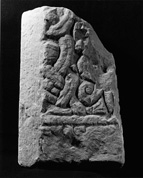
Object type: Part of cross-shaft
Measurements: H. 47 cm (18.5 in); W. 30.5 cm (12 in); D. 14 cm (5.5 in)
Stone type: Medium-grained yellow sandstone (Carboniferous)
Plate numbers in printed volume: 141 - 3
Corpus volume reference: Vol 2 p. 75-76
(There may be more views or larger images available for this item. Click on the thumbnail image to view.)
Rectangular cross-shaft. A plain horizontal border marks the base of the single incomplete panel on both faces A and B. The undecorated section below this border was presumably inserted into a socket or directly into the ground.
A (broad): Part of a fettered ribbon animal is laid diagonally across the panel, its contoured body bound by flat median-incised strands. At the damaged edge of the stone are traces of a hip and, perhaps also part of the animal, a spiral. Below the spiral are two scooped leaves terminating one of the interlace strands.
B (narrow): Unidentifiable interlace whose broad flat strands are median-incised. One strand terminates in a plain pointed lobed leaf; the lobes each carry a drilled hole. Below the leaf is a tightly curled tendril enclosing a pellet.
C (broad) and D (narrow): Recut.
Despite the difficulties of reconstructing the zoomorphic ornament on face A it is clear that its contoured ribbon animal belongs to a familiar Insular Jellinge type. The function of the spiral on this face is uncertain but both spiral hips and spiralling offshoots to strands of interlace are familiar elements in the vocabulary of this style. Face B mixes interlace and foliate motifs. The fusion of these two kinds of decoration had already occurred in pre-Viking England in the art of manuscripts, metalwork and sculpture (see Irton 1), but the Brigham dominance of interlace over scroll seems to be a feature of Viking-period treatments.
