Select a site alphabetically from the choices shown in the box below. Alternatively, browse sculptural examples using the Forward/Back buttons.
Chapters for this volume, along with copies of original in-text images, are available here.


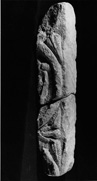
Object type: Part of cross-shaft, in two joining pieces
Measurements: H. 61 cm (24 in); W. 11.5 cm (4.5 in); D. 6.5 cm (2.5 in)
Stone type: Medium-grained red sandstone (St Bees sandstone)
Plate numbers in printed volume: 131 - 2
Corpus volume reference: Vol 2 p. 74-75
(There may be more views or larger images available for this item. Click on the thumbnail image to view.)
There are traces of a flat-band moulding. Carving only survives on one face and it is uncertain whether this was originally broad or narrow. Part of a medallion scroll survives and within it part of a leaf or leaf and berry. At the top right is a leaf which may have been attached to a medallion above. It is of the long triangular veined type, and the detail of the central stem and veins is finely conveyed. Below, a pair of similar leaves flanking a single bud on a stiff stalk fill the space between two medallions.
This fragment must once have been part of a bold imposing scroll which compares in scale with those from Hexham, no. 3 (Cramp 1984, pls. 174–5), and Lancaster (Ill. 679). At Lancaster and Lowther 1 similar leaves with delicate veins and well marked central stems are found, while at Hexham 3 the medallion dividers are similarly organized, but the strands of the scrolls spring from deeply ridged nodes. The composite of a single bud with paired leaves is a very simple form of this type (see G.I., fig. 12c). It is a widespread feature of Cumbrian scrolls (see Introduction, p. 15), and this tantalizing fragment from Brigham demonstrates the variety and popularity of the motif in this region.
