Select a site alphabetically from the choices shown in the box below. Alternatively, browse sculptural examples using the Forward/Back buttons.
Chapters for this volume, along with copies of original in-text images, are available here.


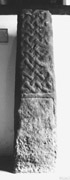
Object type: Part of a cross-shaft
Measurements:
H. 157 cm (61.8 in); W. 43 > 34 cm (16.9 > 13.4 in)
D. 36 > 27 cm (14.17 > 10.6 in)
Stone type: Greyish pink, moderately sorted, medium-grained, clast-supported, feldspathic quartz sandstone; a few scattered flakes of white mica. Sub-angular to sub-rounded clasts vary from 0.3–0.5mm. Millstone Grit Group, Carboniferous (C.R.B.)
Plate numbers in printed volume: Ills. 103, 106–8
Corpus volume reference: Vol 13 p. 145-146
(There may be more views or larger images available for this item. Click on the thumbnail image to view.)
The lower two-fifths of the shaft are undecorated on all four faces, and the carving contained in panels formed by a lower horizontal moulding and vertical arrises on each side.
A (broad): The panel of decoration is filled with an asymmetrical two-stranded interlace pattern formed of turned V-bends. The vertical arrises on each side are badly worn but may have been roll mouldings. The pattern is truncated at the top where the shaft is incomplete.
B (narrow): Decorated by a series of two-stranded, spiraliform interlace patterns joined together by the two stands. At the top, these diminish in size corresponding to the taper on the shaft. The horizontal arrises are badly worn.
C (broad): This face is obscured as it faces the wall, and while inspection suggests that it comprises a badly-worn interlace pattern which may be similar to that on B, Stevenson (1917, 77), illustrates it as similar to that on A. See also Le Blanc Smith 1905b, fig. 7.
D (narrow): This face is decorated by an asymmetrical two-stranded interlace pattern composed of a series of V-bends and plain curves, arranged in a less elaborate design than that on B.
E (top): The top of the shaft appears to have been truncated and hollowed-out with the side above C missing. The top of each of the three sides of the hollowed area are badly worn and damaged. The side above B has striations similar to a cable moulding and there is a nick in the centre of the side above A, but it is unclear whether this was intentional or the result of subsequent wear.
The decoration is limited to interlace patterns which have been carved, lacking in symmetry. In this, it bears similarities with patterns preserved at Derby (nos. 7, 8 and 11), which have been dated to the tenth century, and it is possible that the two sites were connected, especially given the possible provenance of Blackwell 2 (p. 252). At some stage, the top of the shaft was altered to form a hollowed-out bowl or possibly a water stoup or, conceivably, an ornamental object such as a bird-bath.
