Select a site alphabetically from the choices shown in the box below. Alternatively, browse sculptural examples using the Forward/Back buttons.
Chapters for this volume, along with copies of original in-text images, are available here.


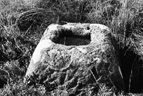
Object type: Cross-base
Measurements:
H. 60 cm (23.6 in); W. 76 > 73 cm (29.9 > 28.7 in); D. 76 > 73 cm (29.9 > 28.7 in)
Socket hole: 26 x 28 cm (10.2 x 11 in)
Stone type: Appears to be of coarse-grained sandstone but is lichen-covered and weathered.
Plate numbers in printed volume: Ill. 477
Corpus volume reference: Vol 13 p. 260
(There may be more views or larger images available for this item. Click on the thumbnail image to view.)
A cross-base with a rectangular socket. The base is roughly square and rests in a peaty depression in an area of heather moorland, so part may be concealed beneath the surface. It is undecorated and tapers inwards slightly from the bottom. The top has round, chamfered shoulders which are of consistent shape all around the stone. The socket in the top suggests it once held a rectangular shaft.
Appendix D item (plain cross-bases)
As an undecorated cross-base, it is impossible to determine whether it is pre-Conquest. Tudor recorded that it was in situ and the base of a boundary cross for Harewood Grange which belonged to Beauchief Abbey (Tudor 1936c). Another observation was that it might have been the base for an eighteenth-century guide stone, but it is unclear that this referred to this particular base (Derbyshire HER No. 1419). It has since been suggested that the base may be Anglo-Saxon and possibly that for the Two Dales cross-shaft (Two Dales 1, p. 231) which presently stands in the churchyard at Bakewell (Scheduled Monument information 31274), but the socket dimensions are not consistent with those of the Two Dales shaft which seems to survive intact at its base.
