Select a site alphabetically from the choices shown in the box below. Alternatively, browse sculptural examples using the Forward/Back buttons.
Chapters for this volume, along with copies of original in-text images, are available here.


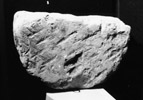
Object type: Architectural component [1]
Measurements: H. 10 cm (4 in); W. 22 > 21 cm (9 > 8.5 in); D. 20 cm. max. (8 in)[2]
Stone type: Yellow buff sandstone
Plate numbers in printed volume: Ills. 458–60
Corpus volume reference: Vol 13 p. 251-252
(There may be more views or larger images available for this item. Click on the thumbnail image to view.)
A (broad): Decorated by a series of horizontal mouldings separated by deep incised grooves. The piece may have been turned on a lathe, but damage to the stone means it is not possible to ascertain this: approximately half of the stone has been broken off, presumably to reuse it as building material. Each moulding is of slightly different widths.
C (broad): The back of the stone is broken.
E (top) and F (bottom): Dressed-off
Appendix A item (stones dating from Saxo-Norman overlap period or of uncertain date)
This appears to be the capital of a relatively small column, and is assumed to have been a component within the early-Norman or, perhaps more probably, the preceding Anglo-Saxon church at Bakewell. Bateman included, in his inventory of antiquary items at Lomberdale House, ‘various Saxon capitals’ found within the walls of Bakewell church, and although his use of the term ‘Saxon’ was not as specific as it might be in current scholarship (often being used to refer to post-Conquest and later medieval carvings), a drawing of one of the so-called ‘Saxon’ capitals may represent this piece. Alternatively, this might have been a generalisation on Bateman’s part as only two capitals are illustrated. If indeed this stone does date to the Anglo-Saxon period, then it may have been reused from a Roman context as was the case in many church buildings of the period (for example, that at Escomb, Co. Durham), and may have originated from the fort at Navio (Brough-on-Noe), about 12 km to the north of Bakewell.
[1] The following are general references to the Bakewell sculptures (other than Bakewell 1): (—) 1845b, 156; Plumptre 1847, 38, 39, 46; (—) 1852, 324; (—) 1855, 67; Hicklin and Wallis 1869, 60; Cox 1877a, 32, 36–7; Cox 1878, 37–8; (—) 1879b, 34; (—) 1885b, 502–3; Allen and Browne 1885, 355; Cox 1887, 37–8; Lynam 1895b, 157; (—) 1900, 89; Cox 1903a; Le Blanc Smith 1904a, 195; Firth 1905, 264; Arnold-Bemrose 1910, 107; (—) 1914a, 401–2; (—) 1914b, 36; Browne 1915, 219; Collingwood 1927, 136; Moncrieff 1927, 86; Tudor 1929, 91; Brown 1937, 94–5; Routh 1937a, 7–8; Routh 1937b, 8–9; Fisher 1959, 72; Thompson 1961, 218; Radford 1961a, 210; Butler 1964, 112; Taylor and Taylor 1965, I, 36; Cramp 1977, 192, 218–19; Pevsner and Williamson 1978, 71; Cramp 1985, 311; Craven and Stanley 1986, 27; Bailey 1990, 2; Jones 1993, 68; Leonard 1993, 48; Sidebottom 1994, 151; Bailey 1996, 11; Barnatt and Smith 1997, 57; Sidebottom 1999, 218; Elliott 2001–2; Sharpe 2002, 61; Hopkinson et al. 2004, 15; Blair 2005, 315, 342, 469–70; Bergius 2012, 189; Stocker and Everson 2015, 16; Ryder 2016, 13, 14, 16, 17
[2] The authors are grateful to Leigh-Anne Williams, Curatorial Assistant, Weston Park Museum, Sheffield, who kindly provided the measurements of the stone at a time when it was inaccessible to the public.
