Volume 13: Derbyshire and Staffordshire
Select a site alphabetically from the choices shown in the box below. Alternatively, browse sculptural examples using the Forward/Back buttons.
Chapters for this volume, along with copies of original in-text images, are available here.
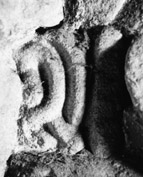
Current Display: Bakewell 07, Derbyshire


Overview
Object type: Possible fragment of a cross-shaft [1]
Measurements: H. 11 cm (4.3 in); W. 10 cm (3.9 in); D. unknown
Stone type: Greyish pink (5R 8/2), poorly sorted, clast-supported, quartz sandstone. The sub-angular to sub-rounded clasts vary from 0.3 to 1.0 mm, but most are between 0.4 and 0.6 mm. Ashover Grit Member?, Marsden Formation, Millstone Grit Group, Carboniferous (C.R.B.).
Plate numbers in printed volume: Ills. 24–25
Corpus volume reference: Vol 13 p. 116
(There may be more views or larger images available for this item. Click on the thumbnail image to view.)
Present Location
Built into interior east wall of south porch
Evidence for Discovery
See Bakewell 2.
Church Dedication
All Saints
Present Condition
A very small fragment but the decoration, visible on only one face, is in good condition.
Description
The decoration appears to form an incomplete scroll or interlace design. It comprises two curved strands, the outer crossed on the bottom right-hand side by another which appears to pass behind the inner curved strand. A small portion of the central area of the decoration visible on the left, appears to be a strand of interlace connecting to the pattern above which is now missing. On the extreme right are the remains of what seem to be an edge-moulding.
Discussion
This stone is too fragmentary to discuss in any detail but if it forms part of a plant-scroll it might be analogous to those elsewhere at Bakewell, for example Bakewell 1.
Date
Probably ninth or tenth century
References
Routh 1937a, 10; Routh 1937b, 11; Sidebottom 1994, 78, 148, 222 (Bakewell 10)
P.S.
Endnotes
[1] The following are general references to the Bakewell sculptures (other than Bakewell 1): (—) 1845b, 156; Plumptre 1847, 38, 39, 46; (—) 1852, 324; (—) 1855, 67; Hicklin and Wallis 1869, 60; Cox 1877a, 32, 36–7; Cox 1878, 37–8; (—) 1879b, 34; (—) 1885b, 502–3; Allen and Browne 1885, 355; Cox 1887, 37–8; Lynam 1895b, 157; (—) 1900, 89; Cox 1903a; Le Blanc Smith 1904a, 195; Firth 1905, 264; Arnold-Bemrose 1910, 107; (—) 1914a, 401–2; (—) 1914b, 36; Browne 1915, 219; Collingwood 1927, 136; Moncrieff 1927, 86; Tudor 1929, 91; Brown 1937, 94–5; Routh 1937a, 7–8; Routh 1937b, 8–9; Fisher 1959, 72; Thompson 1961, 218; Radford 1961a, 210; Butler 1964, 112; Taylor and Taylor 1965, I, 36; Cramp 1977, 192, 218–19; Pevsner and Williamson 1978, 71; Cramp 1985, 311; Craven and Stanley 1986, 27; Bailey 1990, 2; Jones 1993, 68; Leonard 1993, 48; Sidebottom 1994, 151; Bailey 1996, 11; Barnatt and Smith 1997, 57; Sidebottom 1999, 218; Elliott 2001–2; Sharpe 2002, 61; Hopkinson et al. 2004, 15; Blair 2005, 315, 342, 469–70; Bergius 2012, 189; Stocker and Everson 2015, 16; Ryder 2016, 13, 14, 16, 17