Select a site alphabetically from the choices shown in the box below. Alternatively, browse sculptural examples using the Forward/Back buttons.
Chapters for this volume, along with copies of original in-text images, are available here.


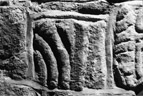
Object type: Part of shaft
Measurements: H. 20.5 cm (8 in); W. 20 cm (7.9 in); D. unknown
Stone type: Greyish orange-pink (5YR 7/2), poorly sorted, clast-supported, feldspathic sandstone with the sub-angular to sub-rounded clasts ranging from 0.3 to 1.0 mm. Millstone Grit Group, Carboniferous (C.R.B.)
Plate numbers in printed volume: Ill. 442
Corpus volume reference: Vol 13 p. 239
(There may be more views or larger images available for this item. Click on the thumbnail image to view.)
This is only a small fragment of what may well have been a cross-shaft. The decoration appears to part of a large scroll type motif. Four curving strands can be seen, the radii of which become smaller as the scroll appears to get closer to its centre on the left. On the right-hand side is what appears to be a moulding around the edge of the panel of decoration with a further damaged moulding to its right, at the edge of the fragment.
It is tempting to see this as part of a large plant-scroll design which was continuous along the shaft. If this was indeed the case, this was probably quite a large monument. Such shafts with large plant-scroll designs are found in the Peak District. At Bakewell, there are several stones bearing plant-scroll designs: Bakewell 2, 4, 7 and 17 all have this type of decoration, but not with this number of strands. However, Bakewell 1, 27, 28 and 31 have more complex plant-scroll designs with multiple strands. There are also similar plant-scroll designs at Bradbourne (1) and Eyam (1). It is not surprising that one such complex plant-scroll design would be found at Wirksworth; along with Bradbourne and Bakewell it was one of the principal centres of the Peak District (Roffe 1986b; Sidebottom 1999) where this type of cross might be displayed.
