Select a site alphabetically from the choices shown in the box below. Alternatively, browse sculptural examples using the Forward/Back buttons.
Chapters for this volume, along with copies of original in-text images, are available here.


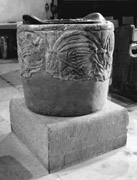
Object type: Remains of column reused (upside down) as font
Measurements:
Overall: H. 61 cm (24 in)
Diameter 67 cm (26.4 in)
Circumference 192.5 cm < 205 cm (75.5 < 80.75 in)
Decoration: H. 39 cm (15.4 in)
Stone type: Light brown (5YR 6/4), poorly sorted, but dominantly coarse-grained, clast-supported, feldspathic sandstone. The sub-angular to sub-rounded clasts vary from 0.4 to 1.5 mm, but are mostly between 0.6 and 0.8 mm across. Helsby Sandstone Formation, Sherwood Sandstone Group, Triassic. Most likely sourced from the Weston Cliff area [SK 394 274] (C.R.B.)
Plate numbers in printed volume: Ills. 426–40; Fig. 46
Corpus volume reference: Vol 13 p. 234-238
(There may be more views or larger images available for this item. Click on the thumbnail image to view.)
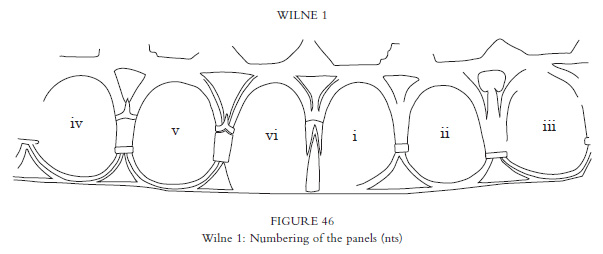
Although originally described by Cox (1879, 399) as if standing the right way up, it has been accepted since Browne’s (1885b) account that the carving is preserved, upside-down, in its current setting, functioning as the upper half of the baptismal font. The following description will treat it as though turned through 180o, with panel i (currently the westernmost: see Fig. 46) being that which was originally set below a figure whose feet were turned in profile to the right, and possibly holding a long staff; the feet of the other five figures were turned to the left. Originally, this register of figures was separated by a wide horizontal moulding from the surviving register of carved decoration, but only the feet, legs and, in some instances the hemlines of a long robe survived; the figures were contained in separate panels arranged in alignment with those below.
The surviving decoration is bounded along its (original) lower edge by a plain flat edge moulding. This is contiguous with a series of curved flat mouldings that forms six elliptic, sub-circular frames (i–vi) containing animal, bird and foliate motifs; the spandrels between these frames and the lower moulding are dressed, but plain. Where the curved frames intersect with each other they are bound by a plain flat band, from which a foliate motif originally sprang between them to fill the upper spandrel (Ills. 427, 434); most of these details have been destroyed. One panel (i), is framed on each side by a moulding that originally formed an arch over it (these are still visible on each side of the panel), but in this instance, the frame emerged only from the band bisecting the frames on either side; it did not continue round the lower quadrants of the panel as is the case with the other five panels. Here the flat edge moulding running around the stone forms the lower frame of the panel.
i (Ills. 428, 435). The panel is filled with the remains of a creature whose body lies against the lower right-hand arc of the frame. It is bounded by a series of vertical parallel ribs, from which emerge five tapering horizontal ribs. The neck of this creature has been damaged, and is currently obscured by cement, but this follows the line indicated by Browne’s rubbing (Ills. 427, 434) as passing up the length of the panel to curve round and back on itself; the small, open-jawed head remains, tucked under the belly, biting on one of the legs that passes through its jaws and up towards the break in the stone. The second leg, which emerges from the horizontal ribs, passes over a ribbon of interlace and curves back to terminate in a slightly clubbed foot behind the head. The left-hand side of the panel is filled with two wide ribbons of interlace, a median line incised down their length. One of these passes over the tapering end of the creature’s body, and terminates in a curl under its lower jaw; the other is lost in the break in the stone.
ii (Ills. 429, 436). A plant with a long central stem, with short curved fronds springing from its length, stands in the centre of the panel; a small curved frond, curling round on itself, grows beside it on the right. Underlying this, and mirrored on the left, are the plain, unadorned, bodies of two bird-like creatures, their necks, following the lines of the frame, curve round on either side of the panel, flanking the central tree; their heads are turned in profile towards the tree, their beaks resting against the upper reaches of the central stem. Only the beak of the bird on the right remains below the break in the stone, but the head of that on the left survives, the eye clearly marked by a deep incision. The neck of the bird on the right is marked with a series of horizontal incisions; that on the left is plain.
iii (Ills. 430, 437). The body of a quadruped, marked with a series of vertical parallel ribs, fills the lower portion of the panel, the line of its back following that of the lower curved frame. On the right, the thick neck is outlined by a narrow moulding on each side, and rises to form the head, which has a prominent skull and mouth. The foreleg on the far side emerges from behind the lower portion of the neck on the left, and extends up towards the break in the stone; the near-side foreleg, with a clearly defined haunch emerging from the parallel ribs of the body, extends at the same angle towards the upper part of the panel. The rear of the body tapers to a narrow point where the hindquarters are transformed into three strands of interlace: one extends up, following the line of the frame on the left, into a knot of interlace; another also extends upwards, before turning to pass under and over the forelegs, into the mouth of the creature; the third passes, in a roughly horizontal direction, to cross over and under the extended forelegs, to terminate behind the creature’s neck on the right.
iv (Ills. 431, 438). The body of a creature in profile fills the lower portion of the panel, forming a curved triangular shape following the curve of the lower frame, with the apex lying by the band bisecting the frame on the right. The lower curve of the body is marked by a series of slightly curved, horizontal ribs, the outermost of which follows the outline of the frame and passes under the band bisecting the frame on the left, which itself extends into the panel. The upper curve of the body is marked by a single moulding that curves upwards into the neck of the creature. The body itself is filled with a series of horizontal ribs that are dislocated two-thirds of the way along their length, and contained in a semi-circular frame. The outline of the chest on the left curves in to the right before protruding slightly as it extends up into the neck, which is lost in the upper break of the stone. Two thin strands, possibly legs, emerge from the body on the left, and extend into the upper left portion of the panel. Following the line of the upper broken edge, is a strand of foliate ornament, from which a branch emerges, behind the neck of the creature, and bifurcates so that one branch curls round its neck and the other passes along the line of its back, to terminate in two small curved fronds.
v (Ill. 432, 439). The profile body of a winged creature fills this panel. It is outlined by plain narrow mouldings, and a collar bisects the neck below the head, which is lost in the break in the stone on the upper right. The chest crosses the panel, protruding out to the left, and a single, much foreshortened foreleg hangs down in the lower left section of the panel. The hind-quarters narrow to a point that extends into a single strand of interlace that curves upwards and passes behind the body to meander in an S-shape below its belly. A well-defined wing extends up from the side of the body, outlined by a narrow moulding, filled with a series of parallel ribs representing feathers that taper up to the tip of the wing that lies behind the head, on the right. A strand of interlace emerges from the remains of a knot in front of the creature’s chest, crosses its neck and passes under the wing, before crossing back over the wing to terminate in a tight curl between the head and the tip of the wing.
vi (Ills. 433, 440). A central foliate motif, growing from a prominent semi-circular mound, fills the centre of the panel. The central stem bifurcates at the point it emerges from the mound, the two outmost stems curving up and round that in the centre, sprouting a number of tightly curled fronds; short leaves sprout from the length of the central stem. The tree is flanked by two birds. That on the left is turned backwards to face the tree, its beak slightly open to grasp the left-hand stem. It has a round head, with an ovoid eye defined by an iris and a central pupil. A collar separates the head from the neck, which is outlined by a narrow moulding on each side, the neck itself being filled with small incisions resembling scale-like feathers. The back of the bird is tucked under the branches of the tree, the body being filled with the same small scale-like feathers as the neck. The lowermost part of the body is defined as a series of parallel vertical ribs that hang down to the lowermost horizontal moulding running around the circumference of the stone. On the right was another bird, whose open beak is still visible beyond the upper break in the stone, grasping the outermost frond on right; the head has been lost. The neck of this bird is outlined by a prominent moulding that extends along the line of the back to the central mound. The neck itself is composed of a series of deeply defined horizontal ribs, while the body, on lower right, is plain.
Although so badly damaged, sufficient of the animal, bird and foliate ornament survives, which, along with the evidence supplied by Browne’s rubbing and the arrangement of the decoration, allows for certain observations concerning the style and potential date of the piece, while further suggestions can be made about the nature of the original monument and the iconographic significance of some of the panels.
Stylistically, the distinctive large fleshy heads of the beasts with their ovoid eyes, small pointed ears and interlacing tongues, along with the interlacing limbs, ribbed bodies and sharply everted pointed wings demarcated with deeply incised lines, all point to a series of coincidences with animal art that flourished in various media in Mercia and the West Midlands during the later eighth and first half of the ninth centuries. Apart from the stylistic analogies that exist between the creatures at Wilne and those on the shafts from Derby St Alkmund (1 and 2), sculptural examples also survive at Sandbach in Cheshire (1), Gloucester (1 and 3), Cropthorne (1) in Worcestershire, and Acton Beauchamp, Herefordshire (Bailey 2010, 99–113; Webster and Backhouse 1991, fig. 25; Cramp 1977, fig. 61.b, d; Bryant 2012, ills. 273, 278-9, 282-3; 621, 625, 630-3; 496, 499), the latter having recently been subjected to detailed study and convincingly situated within the first half of the ninth century (Dales 2006; see now Bryant 2012, 281-3).
The ribbing on the creatures’ bodies and wings (i, iii–vi) is also characteristic of late eighth-century ivory carving, surviving on the Gandersheim Casket (Marth 2000, pls. 1–2; Webster and Backhouse 1991, 177–9, cat. 138), although here the bodies of the animals are more slender and associated with complex interlace designs that do not feature at Wilne. In metalwork and manuscript art the creatures appear in various contexts dateable to the later eighth and early ninth centuries: the distinctive heads are found in the Codex Bigotianus (Paris, Bibl. Nat., MS lat. 281, fol. 137), and the Barberini Gospels, for instance (Rome, Bibl. Apost. Vaticana, MS Barb. Lat. 570, fol. 125), both identified as emerging from later eighth-century Mercian contexts (Webster and Backhouse 1991, 201–2, 205; cat. 155, 160). Dating from the early ninth century are the full-length, winged beasts found in the Royal prayerbook (London, BL, Royal MS 2 A.XX, fol. 17) and the ‘Tiberius’ Bede (London, BL, Cotton MS Tiberius C. ii, fol. 5b: Webster and Backhouse 1991, 163–4, 217; cat. 163, 170).
Of these examples, however, only the creatures at Acton Beauchamp (Ill. 649) have the collar which distinguishes the beast of Wilne 1v, as well as the birds in vi, and which also originally featured in iv (see Ills. 427, 434); this detail is most commonly preserved in metalwork dated to the early ninth century: on a die from Canterbury, for instance, and a pin from York and a brooch from Pentney, Norfolk, to name just a few (Webster and Backhouse 1991, 222, 227, 229–31; cat. 174, 183, 187b). Unlike the creatures featured in metalwork of the mid-ninth century, whose bodies tend to be speckled and more compact, these earlier (ninth-century) examples also display the everted wings, the double-outline round the body and loose interlacing of the limbs and tongues as is the case at Wilne.
Also distinctive here is the plant emerging from the rounded mound in panel vi, whose central stem bifurcates into branches that end in small round terminals and which features curled leaves. This plant-type occurs repeatedly in the mid-eighth-century Stuttgart Psalter (Stuttgardt, Landesbibl., Cod. Bibl. 2o 12, fols. 1, 32, 63), where spear-shaped leaves, like those once found at Wilne in the upper interstices between panels i/ii and v/vi, also occur. The plant-type is also found in the contemporary Vespasian Psalter (London, BL Cotton MS Vespasian A.i, fol. 30b); and it occurs in a sculptural medium on Codford St Peter 1, Wiltshire, which has been dated to the late eighth / early ninth century (Cramp 2006a, 211; see Ill. 648). In none of these instances, however, does the plant emerge from a curved mound; nor is it flanked by birds feeding from its branches as occurs in panel ii where the plant consists of a series of short curved stems branching out on either side of the central stem which, like the manuscript and sculptural versions, features the distinctive binding from which the lowermost branches bifurcate; this may also have been the case in vi, but the surface is too worn to be completely clear in this instance.
While the general features of the animal and foliate ornament thus associate Wilne most closely with art emerging from the west Midlands and Mercia during the later eighth and early ninth century, there are also links with art produced in Carolingian Gaul during this period. The most recent study on the Acton Beauchamp carving in Herefordshire (Bryant 2012), for instance, has highlighted these artistic links which were earlier suggested by Cramp (1977, fig. 61.e); the plant forms at Wilne are also not unknown in continental contexts.
Furthermore, it is in ‘Anglo-Carolingian’ art that the arrangement of the decoration featured at Wilne is to be found: most notably, on the Tassilo Chalice, dated to 777–88 (Webster and Backhouse 1991, 168, cat. 131). This is organised in a series of ovoid panels with wide borders bound by horizontal strips–a detail found at Wilne between panels i/ii and iii/iv/v. Also notable is the arrangement of the panels so that the interstices are filled with foliate motifs. Such details are absent from the Tassilo Chalice, but are preserved on two bowls of late eighth-century date that have emerged from Anglo-Saxon contexts in Lancashire and, more recently in Yorkshire: at Halton (Combe 1817), and the Vale of York (Williams and Ager 2010) (Ills. 654-5); see also early ninth-century Anglo-Carolingian bowls from Ripen and Fejø, Denmark (Haseloff 1990, 27, Abb. 39; Brøndsted 1924, 329; Graham-Campbell and Kidd 1980, 38, pl. 14). Overall, therefore, it seems likely that the piece can be dated to the later eighth or very early ninth century.
In addition to such diagnostic details, the piece at Wilne provides some indication of the nature of the original monument of which it was a part: a sharply tapering cylindrical column that was cut down, inverted and hollowed out to form the font. Furthermore, as demonstrated by Browne (1885, 189-91), its current dimensions correspond with those of the lowest register of the column standing at Wolverhampton in Staffordshire (1). It was thus one of a series of large scale columnar monuments, decorated with registers of animal and figural art that (excluding Wolverhampton), were set up across Anglo-Saxon England at the turn of the ninth century: at Reculver 1 (Kent), and Winchester Priors Barton 1 (Hampshire), in the south east (Tweddle et al. 1995, 46–61, 138, 151–61; 331, 333–4); and at Masham and Dewsbury, Yorkshire, in the north east (Lang 2001, 168–71; Coatsworth 2008, 128–33).
Unlike the columns at Reculver and Dewsbury, which seem to have displayed only figural carving, that at Wilne seems, like the Masham column (Lang 2001, ills. 597-631), to have incorporated a mixture of figural and animal ornament, with the zoomorphic decoration perhaps being situated towards the lower part of the monument. Due to the incomplete nature of Wilne 1 it is, of course, impossible to reconstruct the upper registers which, at Masham, Reculver and Dewsbury all featured the iconographic scheme of Christ enthroned in Majesty and flanked by his apostles, who were arranged in pairs around the circumference of the column (Hawkes 2006, 110–12). At Wilne only six figures, apparently turned in different directions, can be reconstructed and it is unclear where along the length of the column they were originally situated.
Nevertheless, it remains the case that Wilne 1 was, like the other columns, an impressive monument that in its original state would have reflected the concerns of those responsible for its production to emulate imperial monument types, such as the triumphal and Jupiter columns (Hawkes 2009a). As Lang (1999) argued, it is likely that such columns also reflect an awareness of this monument form as having the potential to signify the Church, whose priests were its columns and pillars (O’Reilly 1995, xxiii–viii; Bede, De Temp. II.18:14, in Hurst 1969, 205-6; Connolly 1995, 81–3).
Apart from such potential iconographic references in its monument form, little can be deduced about any symbolic significance conveyed by the decoration of Wilne 1. The row of six full-length figures do not seem to have flanked a central figure, as was the case at Masham, Reculver and Dewsbury–where, moreover, thirteen rather than six figures were originally displayed. Rather, five of the figures at Wilne seem to have been turned to the left, with only one of their number facing right: that one holding an object such as a staff which further distinguished him from the others. While this might suggest that an original identification with Christ flanked by his apostles is unlikely, other groupings of Christ and the apostles did exist in Anglo-Saxon sculpture. The so-called ‘Hedda Stone’ at Peterborough (Huntingdonshire), which has been dated to the later eighth century, portrays six full-length figures arranged in separate panels: Christ, accompanied by the Virgin, Peter, Andrew and two further apostles (Bailey 1990, 8–11, fig. 4: see Ill. 647). It may well be that a more specific grouping was likewise displayed at Wilne.
It is in the register below that the most clearly symbolically significant schemes are preserved: the pair of birds flanking, and feeding from, a central tree-like plant in ii and vi. This is a scheme that was well-established in early Christian art, appearing on Ravennate sarcophagi of sixth-century date, for instance, or Roman reliefs of a similar date and, in an Insular context, on the mid-eighth-century Kildalton cross on Islay where they seem to flank a chalice (Hawkes 2005, fig. 17.2; see also Ramirez 2006, 8–10). Elsewhere it is preserved on the early ninth-century column at Masham where the birds feeding from a vine growing from a chalice provide an iconographic reference clearly intended to denote the Eucharist with the body and blood of Christ signified by the birds (peacocks), and the grapes of the vine (Hawkes 2006, 110–11; see further O’Reilly 1992; Greenhill 1954). At Wilne, the plants are more tree-like with their central stems, and that in vi grows from a pronounced mound at the base of the panel. With these details, it is likely that the schemes refer more specifically to the Tree of Life in Paradise, the mound representing Mt Sion as is often the case in early Christian art from the fifth century onwards (see e.g. Schiller 1971b, pls. 624, 662).
From what survives, therefore, it seems that the iconographic programme of the column at Wilne referred at some level to the Christian community, and the life everlasting available through participation in the sacraments of the Church, founded on Christ, while the monument itself and the style of its carving points to a date of production early in the ninth century.
