Select a site alphabetically from the choices shown in the box below. Alternatively, browse sculptural examples using the Forward/Back buttons.
Chapters for this volume, along with copies of original in-text images, are available here.


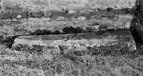
Object type: Complete large grave-cover [1]
Measurements: L. 212 cm (83.5 in); W. 70 > 43 cm (27.6 > 16.9 in); D. c. 20 > 10 cm (7.9 > 3.9 in)
Stone type: A hard Dolomitic Limestone, creamy-white, ooidal texture, no obvious shelly material. Cadeby formation, probably from the Cadeby area
Plate numbers in printed volume: Ills. 160-2
Corpus volume reference: Vol 12 p. 205-6
(There may be more views or larger images available for this item. Click on the thumbnail image to view.)
This is a very large tapered grave-cover of low, coped profile. The decoration consists of a bold, broad, central fillet, of sub-semicircular section running along the ridge of the stone from 'head' to 'foot'. This rib stands mostly in high relief, but at some points variations in the surface of the stone require that it is sunken into the ridge. At two points along this central rib, equidistant from both ends, are two large 'lozenges', originally in high relief. Each lozenge is framed by a bold border of approximate rectangular section, within which lies a slightly sunken field. The stone is too weathered to ascertain whether there was further decoration within the fields defined by the borders. Between each of the lozenges thus defined and the ends of the cover itself the central rib flares outwards somewhat.
Appendix A item (stones dating from Saxo-Norman overlap period or of uncertain date)
The form and decoration of this grave-cover belongs to a larger group of similar monuments extending from Bramcote 1 (above, Ill. 148) some six miles to the north, as far southwards as Cambridgeshire and the Soke of Peterborough. They all adopt lozenges — of slightly differing designs — in the place of a cross-bar, something which is made very clear in the West Leake example by the manner in which the upper and lower arms of the central rib flare outwards towards the edges of the cover. The Lincolnshire monuments of this type, Crowland Abbey 1 and Sleaford 3, have been discussed in some detail within the Corpus format (Everson and Stocker 1999, 146, 290, ills. 143, 429). Lawrence Butler allocated a date in the late eleventh century to some of the more southerly members of this group (1957; 1964, 118–21), and we proposed that the example from Crowland might even be pre-Conquest in date. Butler suggested that the 'lozenge' detail was a distinctive feature of grave-covers from the Barnack group of quarries, but the example at Sleaford is in stone from the Ancaster area, demonstrating that the motif was in use at more than one East Midland production centre. The Permian limestone in which West Leake 1 is worked confirms and extends this observation. Here too the prestigious form and decoration of a Barnack product is reproduced in a local Nottinghamshire stone. West Leake lies nearly thirty miles to the north west of the quarry zone around Barnack, and a direct route traverses many hills and valleys. The journey of a bona fide Barnack product from the quarry would have been difficult and costly, even a route along the river systems requiring several portages; so the desired item was reproduced in a local stone. A similar phenomenon — though copying a different pattern of Barnack cover — can be observed at Aston Flamville in western Leicestershire, where the stone is a reddy-buff local micaceous sandstone (Trubshaw 2004, 24). In these circumstances, it seems probable that the lost Bramcote 1 (above) was also in a local Nottinghamshire stone, rather than a product of the Barnack quarries.
