Select a site alphabetically from the choices shown in the box below. Alternatively, browse sculptural examples using the Forward/Back buttons.
Chapters for this volume, along with copies of original in-text images, are available here.


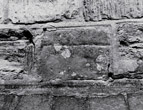
Object type: Grave-cover fragment?
Measurements: L. 26 cm (10.2 in); W. 19 cm (7.5 in); D. Built in
Stone type: Dolomitic Sandstone, yellow-brown, medium to coarse grains in Dolomitic cement. Cadeby formation from the Bulwell area
Plate numbers in printed volume: Ill. 151
Corpus volume reference: Vol 12 p. 202
(There may be more views or larger images available for this item. Click on the thumbnail image to view.)
This stone is a fragment of a much larger block, with a well-defined border moulding running around the two original surviving edges. The angle moulding is near-rectangular in section, and does not represent a fully-formed angle-roll, in contrast to Blyth 1 and North Muskham 1, for example, which might otherwise represent very similar monuments.
Appendix A item (stones dating from Saxo-Norman overlap period or of uncertain date)
Such near-rectangular border mouldings are found on Lincolnshire monuments of the eleventh century, including monuments from quarries in the Ancaster area. Rolleston 3 is a Nottinghamshire example (Ills. 84–5). It is possible, then, that the monument represented here dates from the eleventh century. It would have been a large grave-cover, with an undecorated panel within the border moulding. If correctly interpreted as a fragment from the corner of a large 'chest type' grave-cover, the Halloughton fragment should probably be considered to be of eleventh- or twelfth-century date. Despite the fact that it has a distinctively different type of border moulding, the closest parallels for such a monument would be Blyth 1, Mattersey 1 and North Muskham 1 (Ills. 145–6, 153–4, 156–9).
