Select a site alphabetically from the choices shown in the box below. Alternatively, browse sculptural examples using the Forward/Back buttons.
Chapters for this volume, along with copies of original in-text images, are available here.


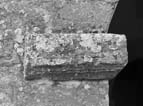
Object type: Impost
Measurements: H. 21 cm (8.2 in); W. (east–west) 47 cm (18.5 in); D. (north–south) 25 cm (9.8 in) max.
Stone type: Greyish orange (10YR 7/4) very shelly sparsely oolitic limestone with clasts supported by a sparry matrix. Shells mostly intact up to 5 cm, some parallel to bedding some more chaotic. Oysters and pectinoids perhaps Propeamussium species. Ooliths 0.3 to 1.0 mm. The lowest part of the Cleeve Cloud Member, Birdlip Limestone Formation, Inferior Oolite, Group, Jurassic. As with Edgeworth 1 (p. 197), may be from the lowest part of that member.
Plate numbers in printed volume: Ills. 119-20; Fig. 22H
Corpus volume reference: Vol 10 p. 160
(There may be more views or larger images available for this item. Click on the thumbnail image to view.)
Chamfered impost. There is an incised groove near to the bottom of the vertical face, and the chamfer is decorated with two shallow concave mouldings divided by a shouldered incised groove.
The south porch doorway appears to be Anglo-Saxon, with Escomb-fashion jambs built from huge stones. The shallow-arched doorhead that rises from the imposts is constructed from non-radial voussoirs. The imposts themselves seem to be contemporary with the other elements of the doorway, and are like simpler versions of the decorated south doorway and chancel-arch imposts in the church (nos. 5–8 above). However, the rest of the porch must be later because it partially overlaps the rebuilt western part of the nave that is probably early twelfth century in date (see Chapter IX, p. 109). Taylor and Taylor (1965, i, 187) suggested that the doorway may originally have been the west door replaced when the tower was built in the fifteenth century. If, as the present author now believes, the nave was rebuilt as a two-storey structure in the early twelfth century, then the surviving Anglo-Saxon south-west and north-west quoins must have been reused, and it would be reasonable to assume that the doorway was also reused. The Taylors' suggestion is, therefore, quite plausible. Alternatively, the doorway may have come from a western porch that was removed when the tower was built.
