Select a site alphabetically from the choices shown in the box below. Alternatively, browse sculptural examples using the Forward/Back buttons.
Chapters for this volume, along with copies of original in-text images, are available here.


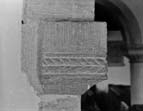
Object type: Impost
Measurements: H. 23 cm (9 in); W. (east–west) 19.5 cm (7.7 in); D. (north–south) 23 cm (9 in); Depth of carved face 21.5 cm (8.4 in)
Stone type: Greyish orange (10YR 7/4) shelly oolite with sparry matrix. Oolith range from 0.2 to 1.0 mm in size. Bedding parallel to top and bottom of capital. Cleeve Cloud Member, Birdlip Limestone Formation, Inferior Oolite Group, Middle Jurassic.
Plate numbers in printed volume: Ills. 110-2; Fig. 22D
Corpus volume reference: Vol 10 p. 159-60
(There may be more views or larger images available for this item. Click on the thumbnail image to view.)
Chamfered impost, decorated with a band of 'wheat-ear' or flat double-cable ornament 1.5 cm (0.6 in) high. Rebated on inner face for door.
The round head of the south door is built with stones laid with non-radial joints, in typical Anglo-Saxon style. This is presumably an original doorway into the church, and dates to the eleventh century. The 'wheat-ear' or flat double-cable decoration of the imposts is in keeping with such a date, and is similar to the double-cable mouldings found around a window at Boarhunt, Hampshire (tenth to eleventh century), or the mid eleventh-century cable decorated imposts at Little Munden and Walkern, both Hertfordshire (Tweddle et al. 1995, 217, 240–1, 251, ills. 318–19, 398–9, 423). Double-cable borders are used widely in Lincolnshire on late tenth- or early eleventh-century gravestones (for example Miningsby 1: Everson and Stocker 1999, 233–4, ill. 301). The sundial above the south door (see Appendix D, p. 273) indicates that there was no porch originally.
