Select a site alphabetically from the choices shown in the box below. Alternatively, browse sculptural examples using the Forward/Back buttons.
Chapters for this volume, along with copies of original in-text images, are available here.


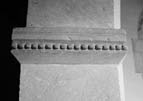
Object type: Impost
Measurements: H. 24 > 23 cm (9.4 > 9 in); W. 78 cm (30.7 in); D. 29 cm (11.4 in)
Stone type: Yellowish grey (5Y 7/2), matrix-supported, shelly oolite. Ooliths (forming some 60 to 70% of the stone) are medium-grained in the range 0.2 to 0.5 mm and set in a micritic matrix; most ooliths have fallen or weathered out to give an 'aero-chocolate' texture. Scattered platy shell fragments (forming some 5 to 10% of the stone) up to 1 cm long aligned horizontally. Farmington Freestone?, Taynton Limestone Formation, Great Oolite Group, Jurassic.
Plate numbers in printed volume: Ills. 89-91
Corpus volume reference: Vol 10 p. 152
(There may be more views or larger images available for this item. Click on the thumbnail image to view.)
Through-stone chamfered impost, decorated with pelleting in a V-shaped groove, above which is a second narrow groove.
The chancel arch is of two orders, the innermost of which carries the carved impost and is constructed entirely of through-stones, a distinctively Anglo-Saxon tradition (Taylor and Taylor 1965, i, 11). An Anglo-Saxon date is further supported by the stepped bases to the pilaster strips on the nave (Coln Rogers 3 and 4). Pelleting is not common in manuscript illumination of the period, but is widespread in ivory and bone carving, especially in the later Anglo-Saxon period (for example, around the mandorla in a late tenth-century Ascension scene, and around the mandorla surrounding Christ in a Traditio Legis carving (Beckwith 1972, 43–6, 122–3, cat. 22, 23, ills. 50, 52, 53). Locally, pelleting is a common feature of late Anglo-Saxon stone carving, seen, for example, on stones from Bibury, Bisley and Broadwell. Very similar imposts can be found at nearby Daglingworth (Daglingworth 5 and 6, Ills. 107–9, 113–15).
There is no pre-Conquest evidence for Coln Rogers, but Domesday Book records that before the Conquest, Coln Rogers was held by Baldwin son of Herluin; there was a priest in 1086 (Moore 1982, no. 1, 22 and note). Herluin was a minister of Bishop Brihtheah of Worcester and accompanied the bishop when he escorted Cnut's daughter, Gunnhildr, to her marriage in 1036 with the future German emperor, Henry III. Baldwin is recorded as having been the steward of Bishop Ealdred of Worcester (c. 1043–1062) and may have been a godson of Edward the Confessor; according to the Domesday survey, Baldwin was a wealthy man in 1066, holding land in seven counties worth ?136 (Clarke 1994, 45, 257–8; Williams 1997b, 388–90).
