Select a site alphabetically from the choices shown in the box below. Alternatively, browse sculptural examples using the Forward/Back buttons.
Chapters for this volume, along with copies of original in-text images, are available here.


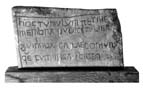
Object type: Inscription panel
Measurements: H. 17 cm (6.7 in); W. 28 cm (11 in); D. 6 cm (2.4 in)
Stone type: Greyish pink (5R 8/2), fine-grained, non-calcareous, clast-supported sandstone. The sub-angular to sub-rounded quartz grains vary from 0.1 to 0.2 mm. St Maughan's Formation? (Lower Old Red Sandstone Group, Old Red Sandstone Super Group), early Devonian age.
Plate numbers in printed volume: Ill. 506
Corpus volume reference: Vol 10 p. 285-6
(There may be more views or larger images available for this item. Click on the thumbnail image to view.)
Found beneath the floor of the church during restoration in 1917–19 (Llewellin 1919, 177–8); the discovery was made under the nave according to (—) 1958–60. The stone was rediscovered in 1959 in a cupboard in the vicarage shortly before its demolition. It was at this time that the lettering was picked out in red ((—) 1958–60).
Inscription incised on a rather irregular rectangular panel. There are four lines of inscription within an incised frame. Several other letters are inscribed above the frame.
Inscription The text is cut in four lines within a rectangular incised frame. It reads:
HOC TVMVLVM RETINE[T]
MEMBRA PVDIC[—]LIE[—]
GVINNDA CAR[—]CONIVN[X]
QVE FVIT IPSA[—]IDEM
Above the frame, in smaller lettering, is also inscribed [A]DEL, or possibly I [A]DEL.
The breaks in the main text which are signalled here are due to flaking of the surface at the right-hand edge and, especially, around the crack that runs diagonally through the stone. Modern paint has been used not only to pick out the inscribed letters but also to fill in these gaps: these additions have no evidential value, and in some cases are almost certainly incorrect.
Following Redknap and Lewis 2007, 529, the main text may be rendered:
Hoc tumulum retinet membra pudic [mu]lie[r] guinnda car[a] coniunx que fuit ipsa [—]idem
'This tomb preserves the limbs of Budic, (she was) the wife of Guinnda, a dear spouse, who was herself ...'
Inscription The inscription is published in detail by Redknap and Lewis 2007, 529–30, with contributions on the palaeography by Gifford Charles-Edwards and on language by Patrick Sims-Williams. The following discussion principally summarises their observations.
Charles-Edwards describes the letter-forms as 'small angular minuscules with some capital forms' and suggests that the neat layout of the small inscription may indicate that the carver was an engraver on metal. Parallels are drawn between the forms of D and G and the script of an early eleventh-century manuscript (Cambridge, Corpus Christi College, MS 41: Temple 1976, 98–9, cat. 81).
Sims-Williams observes that GVINNDA answers to an attested Old Welsh personal name Guinda, whose first recorded bearer is a tenth-century cleric. The name appears to be masculine (possibly simply a variant of Welsh Gwyndaf) which has implications for the interpretation of the text. The following CAR[—] CONIVN[X] seems best restored as cara coniunx, 'dear wife', and taken in apposition not to GVINNDA but to a preceding [MV]LIE[R], mulier 'woman'. In turn, this would stand in apposition to a preceding female personal name PVDIC, which could stand for Old Welsh Budic, equivalent to later Modern Welsh Buddig and to the famous early Boudicca. The whole then gives something like: 'This tomb preserves the limbs of the woman Budic, dear spouse of Guinnda, who was herself ...'. On grounds of sense, and the restricted space in the middle of the sequence PVDIC[—]LIE, this seems a preferable suggestion to other proposed reconstructions of the middle section, which have included membra pudic[a] 'chaste limbs' and pudic[e mu]lier[is] 'of a modest woman'.
The damaged final word of the inscription is obscure: the painted addition of IB to give IBIDEM does not give clear sense. The letters added above the panel are also elusive: Sims-Williams suggests that [A]DEL could be an abbreviated form of an Old English name in Æthel–; Redknap and Lewis that DEL might be for delineavit 'drew'.
With regard to linguistic dating, the most important distinctive feature that Sims-Williams identifies is the development of original w- to gw- in GVINNDA. This is in line with records of Old Welsh that start c. 800, but it is uncertain how much older the change may be, though it clearly post-dates the older, fifth-/sixth-century, stratum of Insular inscriptions (Sims-Williams 2003, 211–14, 288).
Clodock was a large parish in the lee of the Black Mountains, with dependant chapelries at Craswall and Llanveynoe, the latter of which has also produced early sculpture — see p. 287 (for a map of the parishes of the area, see Marshall 1936–8, opposite p. 141). It is evident that the bishops of Llandaff attempted to claim this area as part of their diocese in the early twelfth century, but were unsuccessful (Davies 2003, 66–7); Clodock was in the medieval diocese of St David's, but in 1852 it was transferred to the diocese of Hereford along with certain other parishes in Ewias. The Book of Llandaf, compiled to bolster the vision of his diocese of Bishop Urban (1107–34), contains a section devoted to Clodock, largely hagiographical in character (and including a passio of St Clydog) (Evans and Rhys 1893, 193–7). It has been argued that Clodock was once an episcopal church with a local cult, whose archive had come into the hands of ecclesiastics at Llandaff (Davies 2003, 72, 94–6, 122–4). The hagiographical material is undatable, but there is also the record of a charter in the name of King Ithel ap Morgan of Glywysing, purporting to grant Merthyr Clydog (i.e. Clodock) to Bishop Berthwyn; in its present form, the charter cannot be authentic, but if the name of King Ithel preserves a genuine tradition, a date in the mid-eighth century may be indicated for the original transaction (Davies 1978, 94–5; Davies 2003, 95 n. 125).
