Select a site alphabetically from the choices shown in the box below. Alternatively, browse sculptural examples using the Forward/Back buttons.
Chapters for this volume, along with copies of original in-text images, are available here.


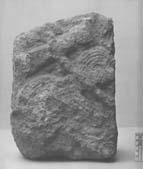
Object type: Architectural panel
Measurements: H. c.27.6 cm (10.8 in); W. c.20 cm (7.9 in); D. 12.5 > 8. 5 cm (4.9 > 3.3 in)
Stone type: Coarse oolitic limestone
Plate numbers in printed volume: Ills. 459-60
Corpus volume reference: Vol 10 p. 258
(There may be more views or larger images available for this item. Click on the thumbnail image to view.)
Architectural. Roughly rectangular fragment from a carved panel. A cross-like feature is carved at an angle across the face of the stone. The other significant features on the stone are two sweeps of multiple-strand 'interlace'.
Appendix A item (stones dating from Saxo-Norman overlap period or of uncertain date).
The British Museum reference card notes 'carving, perhaps fragment of a small tympanum (perhaps Agnus Dei?) ?twelfth cent'. This is presumably Shutter's comment from 1950. The tentative identification with an Agnus Dei must be based upon the cross-like feature noted above in the description, but the two elements of this 'cross' are separate items. The junction between the two is damaged, but the narrow stem actually curves and seems to continue under the horizontal 'arms'. The sweeps of multiple-strand 'interlace' are similar to the loose, multi-strand interlace on a stone reused as the head of a window at Terrington in northern Yorkshire (Lang 2001, 209, ill. 783). It is possible that the 'interlace' on the Chedworth stone might represent waves, and the rather rectangular-shaped object, which is caught in the waves, could, therefore, be a fish. Indeed under raking light the body of this 'fish' appears to terminate at the left in a very fish-like pointed mouth. There is part of a second, narrower, straight-sided element vertically below the 'crest' of the left wave form, and this might be a second fish. The broad band of carving near the top of the stone (see above — the horizontal arms of the 'cross') is not, in fact, straight sided but curves upwards along its upper edge and downwards along the lower edge. The shape is roughly cut-back at the right end, but seems to be complete at the left end. This could be the steering oar of a boat, and the narrow 'stem' that curves across the stone from top left to lower middle right might be a rope attached to a net. There are many maybe's in this description, but all the elements could be part of a representation of the Miracle of the Fishes.
The carving is too badly damaged to allow for close dating. It might be eleventh century, but other stones that seem to be associated with the chapel of St John's Ashes (now built into a wall at the entrance to Court Farm) are probably early twelfth century and this is a more likely date for this carving.
