Select a site alphabetically from the choices shown in the box below. Alternatively, browse sculptural examples using the Forward/Back buttons.
Chapters for this volume, along with copies of original in-text images, are available here.


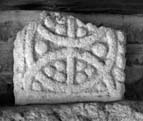
Object type: Grave-cover or decorated respond
Measurements: H. 22 cm (8.7 in); W. 27.3 cm (10.7 in); D. 8 cm (3.1 in)
Stone type: Weathered, very pale orange (10YR 8/2), matrix-supported, micritic, shelly oolite. Ooliths, forming some 30% of the stone, range from 0.4 to 1.0 mm; most ooliths have fallen or weathered out to give an 'aero-chocolate' texture. Elongate shell fragments up to 5 mm across form about 50% of the stone. Taynton stone? Taynton Limestone Formation, Great Oolite Group, Jurassic.
Plate numbers in printed volume: Ills. 87-8
Corpus volume reference: Vol 10 p. 151-2
(There may be more views or larger images available for this item. Click on the thumbnail image to view.)
None. Noted by the Victoria County History (Elrington 1965, 57) and perhaps discovered during the restoration of 1866 (Verey and Brooks 1999, 200).
This small fragment is decorated with a design of interlaced circles, with all available interstices filled with pelleting. A vertical moulding divides the panel into two equal halves. The stone is bordered on both sides with a heavy twisted cord moulding that, in each case, is carried round onto the otherwise plain side face. The back cannot be seen.
This is probably part of a gravestone, although, as with Bibury 5 (p. 138, Ill. 40), it is also possible that this Broadwell stone could be part of the decorated respond from an arch or opening. The decorative scheme is very similar to Osmotherley 2, a tenth-century cross-shaft fragment from northern Yorkshire (Lang 2001, 190–1, ill. 722). In the Cirencester area of Gloucestershire, however, the Broadwell design is closely linked to a group of carved stones from Bibury and Somerford Keynes (pp. 134–8, 243–5, Ills. 27–40, 426–8) that are dated to the first half of the eleventh century.
