Select a site alphabetically from the choices shown in the box below. Alternatively, browse sculptural examples using the Forward/Back buttons.
Chapters for this volume, along with copies of original in-text images, are available here.


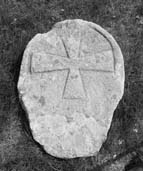
Object type: Incomplete grave-marker
Measurements: H. 54 cm (21.2 in); W. 41 cm (16.1 in); D. 10 > 5 cm (3.93 > 1.97 in)
Stone type: Yellowish grey (5Y 7/2), bedded, shelly, micritic oolite with ooliths ranging from 0.4 to 0.7 mm; shell fragments include bivalves, gastropods, bryozoa and cidarid spines. The bedding is parallel to the upper surface. The ooliths are floating in a micritic matrix; most ooliths have fallen or weathered out to give an 'aero-chocolate' texture. Aston Limestone Formation? Inferior Oolite Group, Middle Jurassic.
Plate numbers in printed volume: Ills. 85-6
Corpus volume reference: Vol 10 p. 150-1
(There may be more views or larger images available for this item. Click on the thumbnail image to view.)
None. Probably among the 'several Norman sepulchral stones' noted by Daubeny (1921, 191) as standing against the south wall of the nave. By 1971 the stone had been moved into the chancel (Butler and Jones 1972, 151–2).
Small grave-marker with a semi-circular top outlined by a narrow half-round moulding. On the front face is a small, equal-arm B6 cross with wedge-shaped or splayed arms (Cramp 1991, fig. 2). The cross is carved in low relief, with the background cut back 3 mm.
Small grave-markers of this type can be late Anglo-Saxon in date (for example no. 7 from Stedham in Sussex (Tweddle et al. 1995, 196, ills. 243–4). The B6 cross type is also found on grave-covers from Carlby in Lincolnshire (Everson and Stocker 1999, 126–7, ills. 84, 86, 87). This grave-marker may, therefore, date to the eleventh century.
