Select a site alphabetically from the choices shown in the box below. Alternatively, browse sculptural examples using the Forward/Back buttons.
Chapters for this volume, along with copies of original in-text images, are available here.


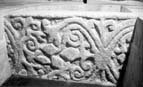
Object type: Grave-cover
Measurements: L. 114 cm (44.9 in); (exposed) 81.4 cm (32 in); W. (exposed) 44 cm (17.3 in); D. 13.5 cm (5.3 in)
Stone type: Yellowish grey (5Y 7/2), clast-supported, shelly, micritic oolite. Ooliths (forming some 60 to 70% of the stone) are medium-grained in the range 0.3 to 0.6 mm; about half of the ooliths have fallen or weathered out to give an 'aero-chocolate' texture. Common scattered platy shell fragments up to 2 mm (forming some 15 to 20% of the stone). Taynton stone?, Taynton Limestone Formation, Great Oolite Group, Middle Jurassic.
Plate numbers in printed volume: Ill. 3; Fig. 30H
Corpus volume reference: Vol 10 p. 126
(There may be more views or larger images available for this item. Click on the thumbnail image to view.)
Noted in its present position by Dryden (1891–2, 128); this carving is likely to have been reused in this position during the thirteenth-century rebuilding of the chancel.
Grave-cover with foliate decoration. There is the remains of limewash on the carved surface. The foliate decoration on this slab consists largely of tendrils which terminate in lobed leaves, spirals and diamond leaf-shapes. Part of an encircled pattern survives at either end of the slab, but only small areas are visible. The carving is coarse and lacks any fine detail. The north edge of the stone is intact and consists of a simple moulding — probably originally a square profile. The southern edge is cut back and obscured — possibly as much as 9 cm (3.5 in) is missing from this side if the design was originally axially centred on the stone.
Most of the decorative elements used in the foliate ornament can be found on the tenth-century grave slab from Gloucester (Gloucester St Oswald 5, Ills. 292–8), but the treatment on the Ampney carving is very different, sharper and less subtle with tight spiralling tendrils (see Chapter VII, Plant Motifs, p. 85). Also the encircling designs at either end of the stone — one of which develops into a figure-of-eight pattern — are more similar to eleventh-century pieces such as the grave-markers from Bibury (nos. 1 and 2, Ills. 27–30).
