Select a site alphabetically from the choices shown in the box below. Alternatively, browse sculptural examples using the Forward/Back buttons.
Chapters for this volume, along with copies of original in-text images, are available here.


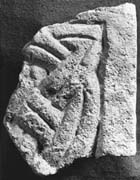
Object type: Cross-shaft(?) fragment
Measurements: H. 10.8 cm (4.2 in); W. 8 cm (3.1 in); D. 5.2 cm (2 in)
Stone type: Pale orange (10YR 8/2) rather shelly, sparry matrix supported oolite. Mainly hollow ooliths (0.2 to 1.0 mm). Shell debris up to 15 mm. Extremely shelly in layer forming top 30 mm of slab. Possibly Taynton Limestone Formation, Great Oolite Group, Middle Jurassic.
Plate numbers in printed volume: Ills. 261-4
Corpus volume reference: Vol 10 p. 206
(There may be more views or larger images available for this item. Click on the thumbnail image to view.)
Fragment with plain border and two adjacent faces.
A: Irregular, median-incised interlace. There is a sharp, rather awkward angle in the interlace below what is probably a horizontal border which divides this from another panel.
B: Too little of this face survives to be able to interpret the deeply carved, curving forms with confidence, but they could be parts of plant tendrils and spirals.
The carving on this fragment seems rather coarse, perhaps hurried, lacking the level of control of design and execution evident in most of the other Gloucester pieces. A date in the middle to late ninth century would seem appropriate.
The church of St Mary de Lode is first recorded in the 1140s when it belonged to Gloucester Abbey; it stood immediately outside the abbey's West Gate and served a very large and mainly rural parish made up principally of the abbey's estates surrounding Gloucester (Heighway and Bryant 1999, 14–16; Bryant and Heighway 2003, 103–4). It has been suggested that St Mary de Lode was in fact older than the abbey and was a church of British origin with responsibility for Gloucester and a substantial hinterland (Bassett 1992a, 26–9); excavation has shown a complex early history with a church on the site by the tenth century at the latest (see Chapter II, p. 7; Bryant and Heighway 2003). The manner in which the relationship between the old minster (later the abbey) and St Mary de Lode developed remains far from clear.
